
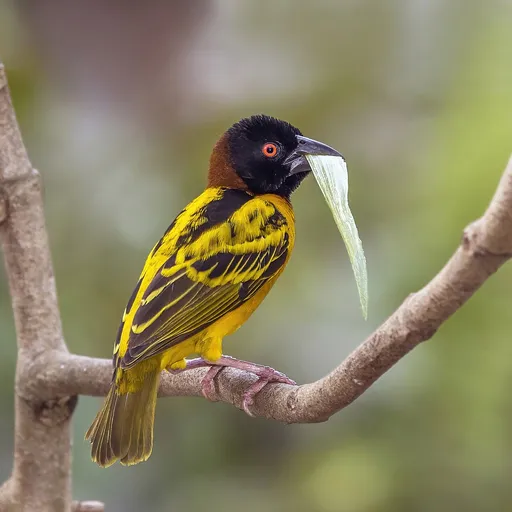
Village Weaver
Ploceus cucullatus
Least Concern
Listen
XC405117 · Anne Ndung'u · Kilifi County, Kenya · CC BY-SA 4.0
Overview
The village weaver (Ploceus cucullatus), also known as the spotted-backed or black-headed weaver, is a stocky bird in the family Ploceidae widely distributed across sub-Saharan Africa. It is characterised by its habit of forming large, noisy colonies in human settlements and open habitats, where it constructs elaborate suspended nests.
Identification
- Stocky body measuring 15–17 cm in length with a strong conical bill and dark reddish eyes.
- Breeding males in the north display a black head edged with chestnut on the nape and chest, while southern males have a black face and throat with a yellow crown.
- Wings feature a distinct black and yellow pattern; non-breeding males and females have olive or streaked upperparts with yellow underparts.
- Vocalisations consist of harsh buzzes and chattering.
Habitat
Found in much of sub-Saharan Africa, excluding the arid regions of the southwest and northeast, this species thrives in open or semi-open environments such as woodlands and human habitation. It has also been successfully introduced to parts of the Caribbean and the Indian Ocean, including Portugal, Venezuela, and several islands.
Diet
Village weavers feed principally on seeds and grain, which can cause them to act as crop pests, but they readily consume insects, particularly when feeding their young. They forage on the ground as well as searching vegetation and trees for food, often joining other weaver species in large groups.
Did you know?
The male weaver constructs the nest's intricate structure using approximately 300 long strips of leaf, which he tears off and transports one by one. He maintains a fixed body position throughout the process, weaving the material by seizing strips and poking them into the structure with a vibrating movement.
Sources
- Wikipedia · CC BY-SA 4.0
- Wikidata · CC0 1.0