
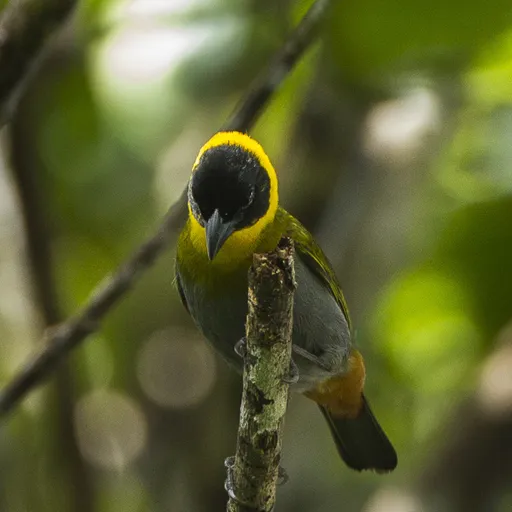
Nelicourvi Weaver
Ploceus nelicourvi
Least Concern
Overview
The nelicourvi weaver (Ploceus nelicourvi) is a slender, sparrow-like bird endemic to Madagascar. It is the only known species in the monotypic genus Nelicurvius and is closely related to the sakalava weaver. The species is currently classified as Least Concern on the IUCN Red List.
Identification
- Breeding males feature a black head and bill, a distinct broad yellow collar, and an olive-green back with blackish flight feathers edged in greenish hues.
- Non-breeding males display mottled grey and green heads, while females have a yellow head front and a broad yellow eyebrow.
- A high-pitched, metallic, and rasping call consisting of 'chizz-chizz-chizz' is heard, particularly when foraging in groups.
- The nest is a conspicuous, solitary, retort-shaped structure made of grass and palm fronds, hanging by a rope from a branch, vine, or bamboo stem.
Habitat
Endemic to Madagascar, the nelicourvi weaver inhabits subtropical and tropical moist lowland and mountain forests. It also occurs in sclerophyllous mountain forests, bushland, and thickets along the eastern belt of rainforest from the Tsanatanana mountains to the south-east.
Diet
This species primarily feeds on insects and arthropods, occasionally consuming small vertebrates such as lizards and chameleons, as well as nectar, fruit, and seeds. It forages alone or in very small groups, often associating with long-billed bernierias, by probing crevices, hanging from vines, and dismembering flowers.
Did you know?
The nest construction is a collaborative process taking approximately twelve days, with the male building the structure from strips of grass and sedge while the female supplies the lining material. The species is also notable for its distinct vocalisations, which become more metallic and rasping when the birds are in feeding groups.
Sources
- Wikipedia · CC BY-SA 4.0
- Wikidata · CC0 1.0