
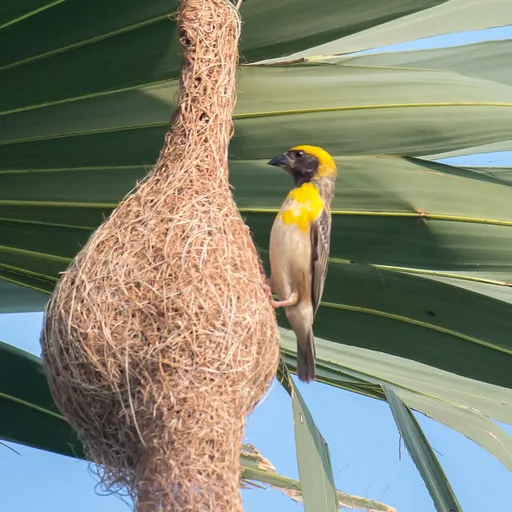
Baya Weaver
Ploceus philippinus
Least Concern
Overview
The baya weaver (Ploceus philippinus) is a common weaverbird found across the Indian subcontinent and Southeast Asia. These social birds are widely distributed and often observed in flocks within cultivated and natural grassland environments.
Identification
- Sparrow-sized at approximately 15 cm, with a stout conical bill and a short square tail.
- Non-breeding plumage is dark brown streaked fulvous buff above and plain whitish fulvous below, resembling female house sparrows.
- Breeding males display a bright yellow crown, dark brown mask, and yellow breast, while the bill turns blackish brown.
- Calls consist of a continuous 'chit-chit' sound, sometimes ending in a wheezy 'cheee-eee-ee'.
Habitat
This species inhabits grasslands, cultivated areas, scrub, and secondary growth across the Indian subcontinent and Southeast Asia. Flocks typically frequent areas near or hanging over water and are prone to seasonal movements in response to rain and food availability.
Diet
Baya weavers forage in flocks for seeds on plants and on the ground, frequently gleaning paddy and other grains in harvested fields. They also consume insects, including butterflies, and occasionally take small frogs, geckos, and molluscs, particularly to feed their young.
Did you know?
Males construct elaborate, pendulous, retort-shaped nests by making up to 500 trips to cut and weave strips of paddy leaves and palm fronds. They also add blobs of mud or dung to the interior of the nest chamber, which may help stabilise the structure in strong winds.
Sources
- Wikipedia · CC BY-SA 4.0
- Wikidata · CC0 1.0