
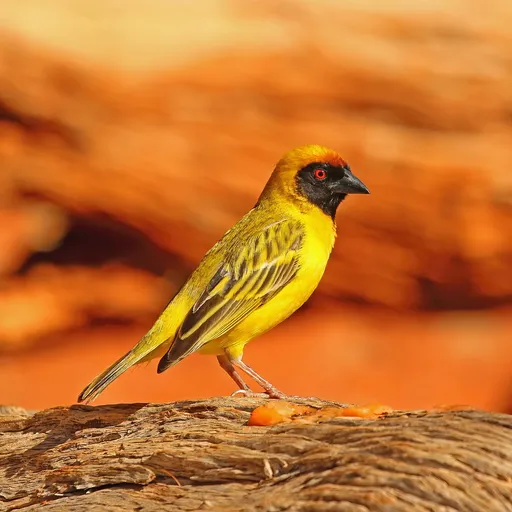
Southern Masked Weaver
Ploceus velatus
Least Concern
Overview
The southern masked weaver (Ploceus velatus), also known as the African masked weaver, is a resident breeding bird species that is common throughout southern Africa. It is a very widespread species that is listed as Least Concern on the IUCN Red List.
Identification
- Males in breeding plumage have a black face, throat and beak, a red eye, bright yellow head and underparts, and a plain yellowish-green back.
- The bird is 11–14.5 cm long with a short, strong, conical bill and pinkish brown legs.
- Females are dull greenish-yellow, streaked darker on the upper back, with a pinkish-brown bill and brown or red-brown eyes.
- The call is a harsh swizzling sound, and the bird also utters a sharp chuk alarm note.
Habitat
This weaver inhabits a wide range of environments, including shrubland, savanna, grassland, open woodland, inland wetlands and semi-desert areas. It is also frequently found in sub-urban gardens and parks across its southern African range.
Diet
The southern masked weaver feeds on insects, seeds and nectar, often foraging singly or in small groups, though it may also form larger flocks with other seed-eating species. It will also visit feeding tables.
Did you know?
The species lays eggs of various colours to evade parasitisation by cuckoos, which are forced to enter the nest to check the egg colouration before attempting to lay their own.
Sources
- Wikipedia · CC BY-SA 4.0
- Wikidata · CC0 1.0