
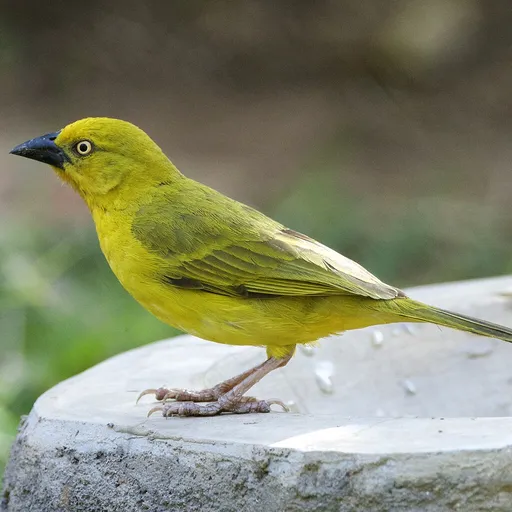
Holub's Golden Weaver
Ploceus xanthops
Least Concern
Overview
The Holub's golden weaver (Ploceus xanthops), also known as the African golden weaver, is a species of bird in the family Ploceidae. It is classified as Least Concern on the IUCN Red List and is believed to have a stable population trend.
Identification
- Males possess full yellow heads, bright greenish-yellow bodies, and a patch of orange extending from the chin to the upper breast, while females are duller with yellow restricted to the forehead.
- Both sexes feature light yellow eyes, black bills, and pink legs, contrasting with dull brown upper wings and yellow lower wings.
- Juveniles appear in dull olive plumage with dark brown eyes and pale brown bills, displaying yellow only on the tail, chin, and throat.
- The usual call is described as "chichi-chichi-chi-squirr ski-wee," though some regional contact calls are a short "chirp."
Habitat
Found across seventeen countries from Gabon to Uganda and Kenya, extending south to northern Namibia, Botswana, and eastern South Africa, the species inhabits inland areas near freshwater. It occupies a variety of habitats including forests, savannas, shrublands, grasslands, and wetlands, often near forest margins or streams, with coastal presence from East South Africa to West Angola. The bird is assumed to be sedentary, living at elevations between 1,200 and 2,300 meters without seasonal migration.
Diet
This omnivorous species consumes invertebrates such as beetle larvae, termites, grasshoppers, praying mantises, tabanid flies, and spiders, alongside fruits like guavas, figs, and rhus pyroides. It also feeds on the seeds of grass and Exocarpus, the nectar of Ruttya and Erythrina, and occasionally eats flower petals.
Did you know?
Males construct nests two to two and a half meters up in tall bushes or reeds, usually over water, while the females are responsible for creating the lining. Old nests from species such as the Brown Firefinch, White-collared Oliveback, and Zebra Waxbill have been found in their breeding sites.
Sources
- Wikipedia · CC BY-SA 4.0
- Wikidata · CC0 1.0