
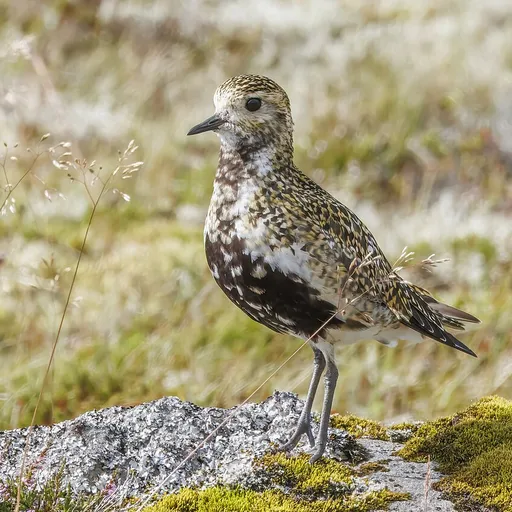
European Golden Plover
Pluvialis apricaria
Least Concern
Listen
XC730599 · Sonothèque ADVL · Vains, Manche, Normandie, France · CC0 1.0
Overview
The European golden plover, also known as the Eurasian golden plover, is a relatively large species of plover that is currently listed as Least Concern by the IUCN Red List. It is the largest of three golden plover species, distinguished from the smaller and slimmer American and Pacific golden plovers. This monotypic species is notably abundant in Iceland, which holds approximately one-third of the global population.
Identification
- A thickset body with wings only slightly longer than the tail.
- A distinct white 'S'-shaped band stretching from the forehead to the flanks.
- White axillary (armpit) feathers, which contrast with the grey axillary feathers of the American and Pacific golden plovers.
- A monosyllabic, slightly descending, melancholic call that sounds like 'tuu'.
Habitat
This species breeds in Arctic tundra and other moorland areas, with a range extending from Iceland in the west to central Siberia in the east. During winter, it migrates to milder regions in Europe, northwest Africa, and southwest Asia, favouring open areas such as agricultural plains, ploughed land, and short meadows. Vagrants have occasionally been recorded as far west as the east coast of Canada and as far east as Pakistan and northern India.
Diet
In the United Kingdom, golden plover chicks rely on craneflies for feeding, whereas march flies are more important in Sweden. The provided reference material does not specify the foraging techniques or the diet of adult birds.
Did you know?
The first European golden plover to arrive in Iceland is traditionally considered a herald that spring has arrived, an event widely covered by Icelandic media. In 2020, the first sighting of the year occurred on 16 March.
Sources
- Wikipedia · CC BY-SA 4.0
- Wikidata · CC0 1.0