
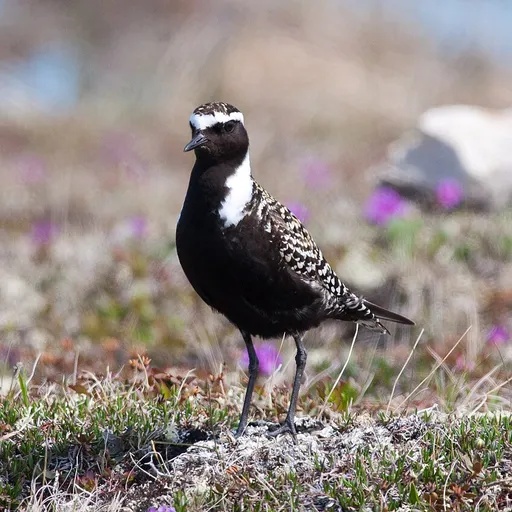
American Golden Plover
Pluvialis dominica
Least Concern
Listen
XC934270 · Doug Hynes · Landing Lake, Churchill, MB, Canada · CC BY-SA 4.0
Overview
The American golden plover (Pluvialis dominica) is a medium-sized plover that breeds in the Arctic tundra of Canada and Alaska. It is migratory, following an elliptical route to winter in southern South America, making it one of the longest known migratory routes among bird species.
Identification
- Breeding adults feature a black face, neck, breast, and belly with a white crown and nape extending to the breast sides, while the back is mottled black and white with pale gold spots.
- Non-breeding plumage is grey-brown on the upperparts with pale grey-brown underparts and a whitish eyebrow.
- A solid black lower belly and undertail in breeding plumage distinguish it from similar European and Pacific golden plovers, which typically have white on the flanks.
- Measuring 24–28 cm in length, the species has a relatively long-legged build compared to the European golden plover.
Habitat
Breeding habitat consists of dry, open areas in the Arctic tundra of northern Canada and Alaska, where the bird nests on the ground. It winters in southern South America, specifically Patagonia, and may stage in central locations such as Illinois during northbound migration.
Diet
These birds forage on tundra, fields, beaches, and tidal flats, usually by sight. Their diet includes terrestrial earthworms, snails, insects, insect larvae, crustaceans, fish, berries, and seeds.
Did you know?
The American golden plover traverses over 40,000 km annually, with a non-stop flight of 3,900 km over open ocean sustained entirely by body fat stores accumulated before the journey. It was one of the most likely shore birds to have attracted Christopher Columbus's attention to the nearby Americas in 1492.
Sources
- Wikipedia · CC BY-SA 4.0
- Wikidata · CC0 1.0