
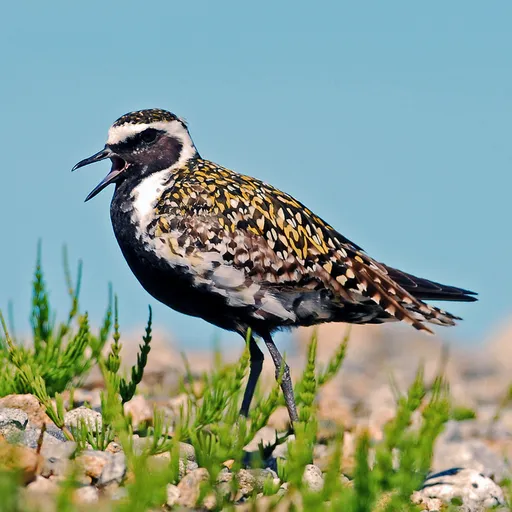
Pacific Golden Plover
Pluvialis fulva
Least Concern
Listen
XC926294 · Jochem Verweij · Ögiy, O'giinuur, Arkhangai, Mongolia · CC BY-SA 4.0
Overview
The Pacific golden plover (Pluvialis fulva) is a migratory shorebird that breeds in the Arctic tundra of Alaska and Siberia during the summer. Outside the breeding season, this medium-sized plover migrates widely across the Pacific basin to Asia, Australasia, and Pacific islands.
Identification
- Breeding adults feature a gold and black spotted crown, back, and wings, with a black breast bordered by white on the face and neck.
- Nonbreeding plumage is uniform across sexes, replacing black and white markings with dark brown, grey, and yellowish patterns on lighter underparts.
- Males are slightly more distinct in breeding plumage, whereas females have a less distinct, mottled black breast.
- The species is slimmer with longer legs and usually more yellow on the back than the similar American golden plover.
Habitat
Breeding occurs in Arctic tundra areas of Siberia and western Alaska, while nonbreeding populations occupy open spaces with short vegetation such as mowed grass, beaches, and tidal flats. In Hawaii, the birds have adapted remarkably to human-altered environments, including backyards, parks, cemeteries, and golf courses.
Diet
Foraging occurs on tundra, mowed grass, and coastal flats via a repeated run-stop-peck pace. The diet is highly varied, consisting of nearly anything that crawls, such as insects, spiders, mollusks, crustaceans, and small reptiles, alongside berries, leaves, and seeds.
Did you know?
In Hawaii, these site-faithful birds, known locally as kōlea, are sometimes named and hand-fed by the public, with some individuals becoming tame around their regular caretakers.
Sources
- Wikipedia · CC BY-SA 4.0
- Wikidata · CC0 1.0