
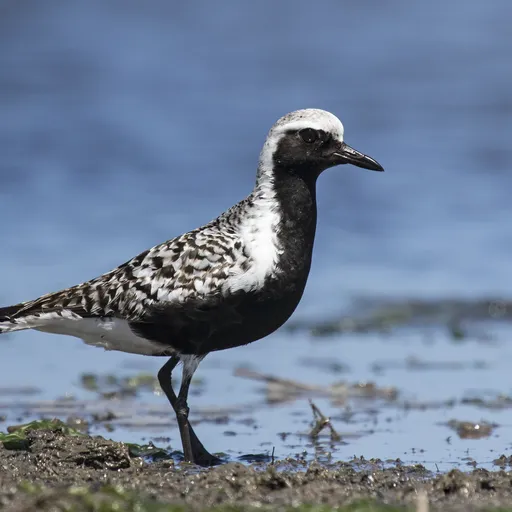
Grey Plover
Pluvialis squatarola
Vulnerable
Listen
XC818497 · Sonothèque ADVL · Vains, Manche, Normandie, France · CC0 1.0
Overview
The grey plover, also known as the black-bellied plover, is a large plover that breeds in Arctic regions and serves as a long-distance migrant with a nearly worldwide coastal distribution when not breeding. It is currently classified as Vulnerable on the IUCN Red List.
Identification
- Summer plumage: Spotted black and white on the back and wings, with a black face and neck bordered in white, a black breast and belly, and a white rump.
- Winter plumage: A fairly plain grey above with a grey-speckled breast and white belly; juveniles resemble this but have blacker back feathers with creamy white edging.
- Structure: Measures 27–30 cm in length with a 71–83 cm wingspan; possesses a notably large and heavy bill (24–34 mm) and black legs.
- Flight: Black inner flanks and axillary feathers distinguish it from other Pluvialis species in flight.
Habitat
Breeding takes place on Arctic islands and coastal areas across the northern coasts of Alaska, Canada, and Russia, specifically in dry, open tundra with good visibility. Outside the breeding season, the species inhabits coastal areas throughout the world, ranging from Ireland and southwestern Norway to South Africa, and from southwest British Columbia to Argentina and Chile.
Diet
The bird forages for food on beaches and tidal flats, usually by sight, consuming small molluscs, polychaete worms, crustaceans, and insects. It is less gregarious than other plover species, feeding widely dispersed over beaches rather than in dense flocks, though it may form dense flocks on high tide roosts.
Did you know?
The genus name Pluvialis means 'relating to rain', stemming from the old belief that these birds flocked when rain was imminent. Additionally, most of the grey plovers that migrate to Australia are female.
Sources
- Wikipedia · CC BY-SA 4.0
- Wikidata · CC0 1.0