
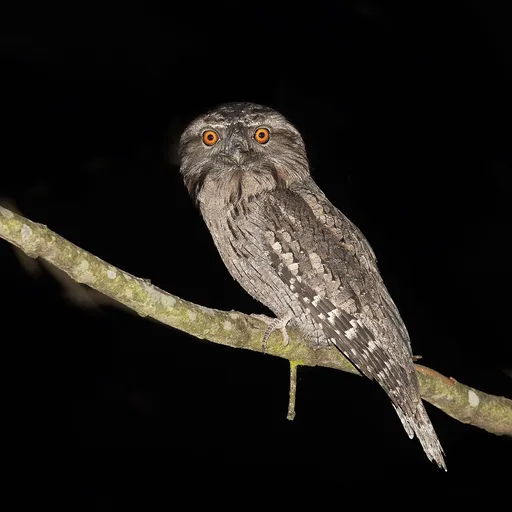
Tawny Frogmouth
Podargus strigoides
Least Concern
Overview
The tawny frogmouth (Podargus strigoides) is a stocky, big-headed bird native to the Australian mainland and Tasmania. It is frequently mistaken for an owl due to its nocturnal habits and similar appearance, but it is an insectivore that relies on camouflage rather than predation.
Identification
- Size and build: Large, stocky bird measuring 34 to 53 cm in length, with rounded wings and short legs.
- Plumage: Predominantly silver-grey with black streaks on the upperparts and white barring with brown or rufous mottling on the underparts; distinct chestnut and rufous female morphs exist in certain subspecies.
- Head and eyes: Wide, heavy, olive-grey to blackish bill hooked at the tip with bristle tufts; large yellow eyes positioned to the sides of the face rather than forward.
- Vocalisations: Emits a deep, continuous "oom-oom-oom" grunting call at night, along with soft "whoo-whoo-whoo" sounds and distinctive drumming during the breeding season.
Habitat
Found throughout most of the Australian mainland and Tasmania, excluding far western Queensland, the central Northern Territory, and the Nullarbor Plain. It inhabits diverse environments including forests, woodlands, scrub, heathland, and savannahs, while avoiding heavy rainforests and treeless deserts. These birds are also common in urban residential suburbs, often nesting in parks and gardens with trees.
Diet
The diet consists primarily of large nocturnal insects such as moths, as well as spiders, worms, slugs, snails, and other invertebrates, with occasional consumption of small mammals, reptiles, and birds. Foraging involves pouncing from an elevated perch to capture prey on the ground or in flight using its beak. Captured prey is held in the beak and transported to a branch, where insects are pulped or larger vertebrates are killed by striking against the branch before consumption.
Did you know?
To survive cold winters, tawny frogmouths enter a state of torpor that can reduce their body temperature by up to 10 °C, significantly slowing their heart rate and metabolism to conserve energy. They also use a complex cooling mechanism in summer, producing mucus to chill inhaled air and engorging mouth blood vessels when overheating.
Sources
- Wikipedia · CC BY-SA 4.0
- Wikidata · CC0 1.0