
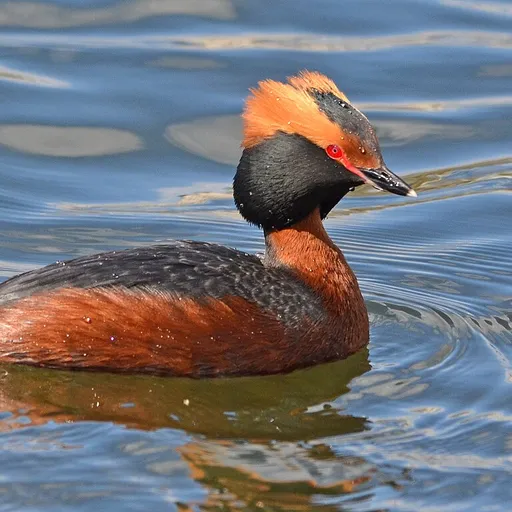
Horned Grebe
Podiceps auritus
Vulnerable
Overview
The horned grebe, or Slavonian grebe (Podiceps auritus), is a relatively small and threatened waterbird classified as Vulnerable on the IUCN Red List. The species is divided into two subspecies: the Eurasian P. a. auritus and the North American P. a. cornutus, with populations experiencing significant declines due to habitat loss and human disturbance.
Identification
- Measuring 31–38 cm in length, the bird features a straight, pointed beak with a white tip and a flat forehead.
- In breeding plumage, it displays bright orange-yellow crest feathers known as 'horns' above and behind the eyes, along with black fan-shaped cheek feathers and chestnut-brown flanks.
- Non-breeding plumage is black and white, with a straight border behind the eyes separating the white cheeks from the dull black-grey crown.
- The advertising call is a loud, nasal 'aaarrh' that descends in pitch and ends in a trill.
Habitat
Breeding occurs primarily in boreal and subarctic regions with a frost-free period of 90 days or less, though it also breeds in temperate zones such as prairies and parklands. It prefers shallow freshwater ponds, marshes, and lake edges with emergent vegetation and submerged plants, often selecting lakes less than 2.5 m deep. During winter, the species moves to marine environments including estuaries, bays, and sandy beaches, although large numbers may congregate on inland lakes in some locations.
Diet
Horned grebes dive underwater using their large feet for agile manoeuvrability to feed on aquatic arthropods, fish, and crustaceans, also catching airborne insects on the water's surface. They prefer aquatic and airborne arthropods in summer, shifting to fish and crustaceans in winter. An adaptation allows them to swallow fish whole, utilizing a matted plug of feathers in the stomach to filter out bones.
Did you know?
Horned grebes eat their own feathers from a young age to create a matted plug in the stomach that functions as a filter to hold fish bones until digestion. They are also extremely vocal during breeding, performing elaborate ceremonies such as the 'weed ceremony' where the pair dives and rises in synchronisation with retrieved weeds.
Sources
- Wikipedia · CC BY-SA 4.0
- Wikidata · CC0 1.0