
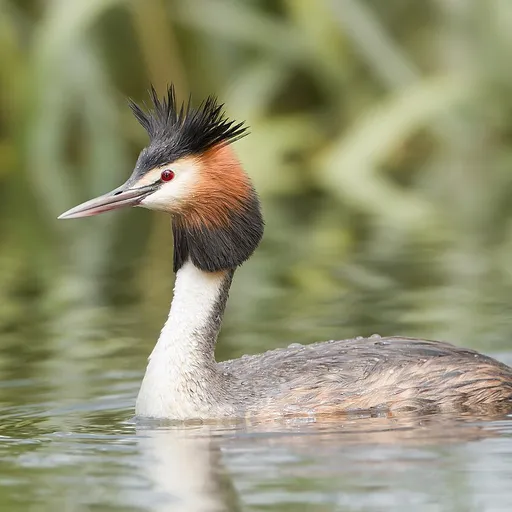
Great Crested Grebe
Podiceps cristatus
Least Concern
Listen
XC834772 · Grégoire Chauvot · Lidingö, Danderyd Municipality, Stockholms län, Sweden · CC0 1.0
Overview
The great crested grebe (Podiceps cristatus) is the largest species of grebe in the Old World and a member of the water bird family. It is characterised by striking plumage and an elaborate courtship display involving synchronised dances. Currently listed as Least Concern, this species is also known in New Zealand by its Māori name, pūteketeke.
Identification
- Size: Measures 46–51 cm long with a wingspan of 59–73 cm, weighing between 0.9 and 1.5 kg.
- Plumage: Adults in summer display black, orange-brown, and white feathers with head and neck decorations; winter plumage is whiter with a white patch above the eye and a pink bill.
- Chicks: Juveniles have boldly striped heads with alternating black and white bands, resembling humbug sweets, which they lose during their first winter.
- Call: Produces a loud barking 'rah-rah-rah', a clicking 'kek' sound, and deep growls.
Habitat
Breeds in vegetated areas of freshwater lakes and winters on freshwater lakes, reservoirs, or the coast. The subspecies P. c. cristatus spans Europe and the Palearctic, being resident in the milder west but migrating from colder regions. African and Australasian subspecies are mainly sedentary in tropical and subtropical regions.
Diet
Feeds mainly on fish, but also consumes small crustaceans, insects, small frogs, and newts. It is an excellent swimmer and diver that pursues its prey underwater.
Did you know?
In the 19th century, the species was hunted almost to extinction in the United Kingdom for its head plumes, which were used to decorate ladies' hats and garments. This threat directly led to the establishment of the Royal Society for the Protection of Birds.
Sources
- Wikipedia · CC BY-SA 4.0
- Wikidata · CC0 1.0