
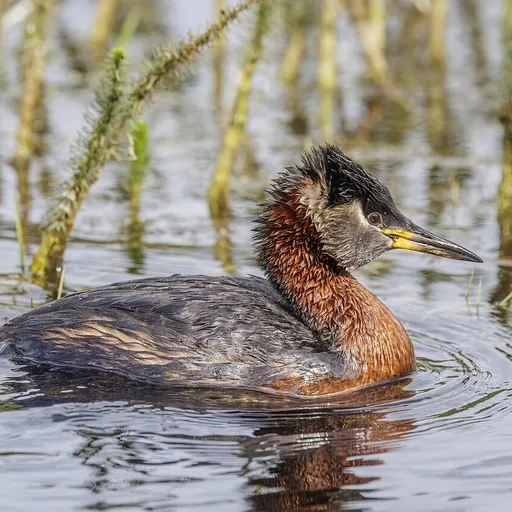
Red-necked Grebe
Podiceps grisegena
Least Concern
Overview
The red-necked grebe (Podiceps grisegena) is an aquatic bird native to the temperate regions of the northern hemisphere. It is a migratory species that prefers shallow freshwater bodies for breeding, but its wintering habitat is largely restricted to calm coastal waters. Two subspecies exist: the nominate P. g. grisegena in Europe and western Asia, and the larger P. g. holbolii in North America and eastern Siberia.
Identification
- In breeding plumage, the bird features a distinctive rusty red neck, a black cap extending below the eye, and very pale grey cheeks and throat, contrasting with a dark grey back and white underparts.
- The bill is long, pointed, and black with a yellow base, while the eyes are dark brown.
- Winter plumage is drab and dusky grey, with a dark grey cap that merges into the face, a pale crescent around the rear of the face, and a whitish front neck.
- One of the most vocal grebes in the breeding season, it produces a loud, wailing or howling display call described as 'uooooh', often given in duet.
Habitat
Breeding occurs in shallow inland bodies of water, such as freshwater lakes, bays, marshes, and fish-ponds, often less than 2 m deep and characterised by abundant emergent vegetation like reedbeds. The species prefers inland temperate climates in forested areas or shrub tundra, avoiding subarctic and warm temperate zones. During winter, it migrates to coastal waters, typically in estuaries, bays, or offshore areas with water less than 15 m deep over sand or gravel bottoms.
Diet
On breeding grounds, the red-necked grebe feeds mainly on invertebrates, including aquatic insects like water beetles and dragonfly larvae, crayfish, molluscs, and crustaceans, with fish becoming important locally or seasonally. It forages by diving to reach aquatic prey or by picking terrestrial insects from vegetation, often using a line of sight from the eye to the bill tip to locate food. During winter, the diet shifts to mainly fish.
Did you know?
The red-necked grebe swallows large quantities of its own feathers, which decompose in the stomach into a felt-like mass; this behaviour is suggested to protect the lower digestive tract from bones and other hard, indigestible material. Parents often feed these feathers to their young, sometimes within a day of hatching.
Sources
- Wikipedia · CC BY-SA 4.0
- Wikidata · CC0 1.0