
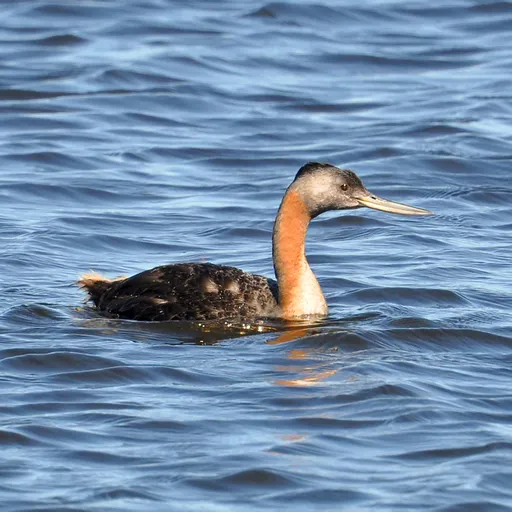
Great Grebe
Podiceps major
Least Concern
Overview
The great grebe (Podiceps major) is the largest species of grebe in the world, distinguished by proportions that resemble a goose or cormorant more than typical members of its group. It holds a Least Concern status on the IUCN Red List and maintains a disjunct population in northwestern Peru alongside a main distribution spanning from extreme southeastern Brazil to Patagonia and central Chile.
Identification
- Podiceps major is a very large bird, ranging from 67 to 80 cm in length, with a body shape similar to a goose or cormorant.
- Plumage features a buffy-rufous neck and chest, a blackish back, and a whitish belly.
- The head is sooty grey with a distinct reddish-brown eye.
- Due to its size and unique coloration, it is unlikely to be confused with any other bird, including other grebes.
Habitat
This species occurs mainly in open waterways, typically inhabiting low-altitude lakes, sluggish rivers often surrounded by forests, and estuarine marshes. During breeding, it frequents heavily vegetated inlets of large lakes, while non-breeding birds move to estuaries, bays, or occasionally the open sea. The main distribution extends from extreme southeastern Brazil to Patagonia and central Chile, with a disjunct population in northwestern Peru.
Diet
The great grebe feeds mostly on fish, sometimes over 11 cm long, along with insects, crustaceans, and mollusks. In winter along the coasts, its diet can shift to include crabs, constituting almost half of its intake, and it may also take the young of other waterbirds such as coots.
Did you know?
The scientific binomial Colymbus major was coined by Pieter Boddaert in 1783 to illustrate a specimen that Buffon mistakenly believed had come from Cayenne in French Guiana. The bird was originally described without a scientific name, appearing only in Buffon's Histoire Naturelle des Oiseaux.
Sources
- Wikipedia · CC BY-SA 4.0
- Wikidata · CC0 1.0