
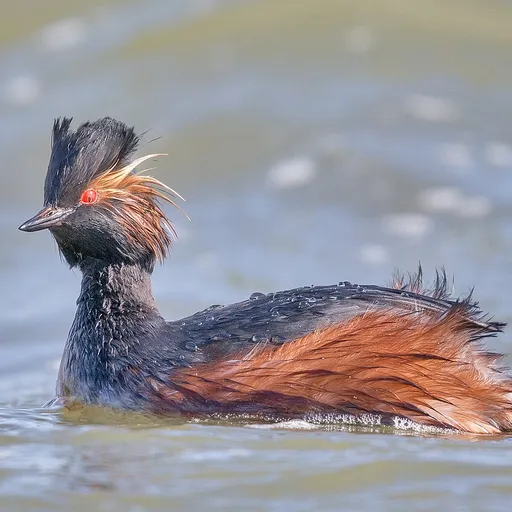
Black-necked Grebe
Podiceps nigricollis
Least Concern
Overview
The black-necked grebe, also known as the eared grebe, is a small water bird in the grebe family. It is likely the most numerous grebe in the world and is classified as a species of least concern by the IUCN.
Identification
- In breeding plumage, the head, neck, and breast are black to blackish brown, with distinctive ochre-coloured feathers extending behind the eye and over the ear coverts.
- The flanks are tawny rufous to maroon-chestnut, while the abdomen is white; the eye is a vivid bright red.
- During the non-breeding season, the upper parts are greyish-black with a vertical stripe on the back of the neck, and the bill is significantly more grey than in breeding plumage.
- When breeding, the bird produces a quiet 'ooeek' that ascends in pitch, as well as a low and fast trill used in courtship.
Habitat
This species breeds in vegetated areas of freshwater lakes across temperate Europe, Asia, eastern and southern Africa, and parts of North America. When not breeding, its habitat is primarily saline lakes, sheltered inshore seas, and coastal estuaries.
Diet
The black-necked grebe forages mainly by diving to catch insects, crustaceans, molluscs, tadpoles, small frogs, and fish. When moulting at saline lakes, it feeds mostly on brine shrimps, likely using its large tongue to block the oral cavity and crush the prey against its palate to remove excess water.
Did you know?
During migration, this species travels as far as 6,000 kilometres and can become flightless for at least a month after arriving at a safe area to moult, during which time it can double in weight.
Sources
- Wikipedia · CC BY-SA 4.0
- Wikidata · CC0 1.0