
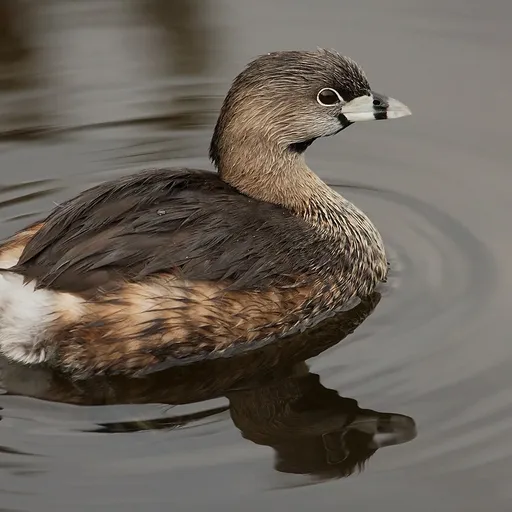
Pied-billed Grebe
Podilymbus podiceps
Least Concern
Listen
XC1090720 · Pedro Sanetti · Neuquen, Confluencia Department, Neuquén Province, Argentina · CC0 1.0
Overview
The pied-billed grebe (Podilymbus podiceps) is a small, stocky water bird that is the sole surviving member of the genus Podilymbus. Commonly known as the American dabchick, it is a species of grebe primarily found in freshwater wetlands throughout the Americas. The species is classified as Least Concern on the IUCN Red List, though populations in New England are declining.
Identification
- Size: 31–38 cm long with a wingspan of 45–62 cm; stocky and short-necked.
- Plumage: Primarily brown with a darker crown and back; white undertail; black throat in summer.
- Bill: Short, blunt, and light grey, encircled by a broad black band in summer.
- Vocalization: Loud, unique call described as a "whooping kuk-kuk-cow-cow-cow-cowp-cowp".
- Feet: Lobed toes rather than webbed, positioned far back on the body.
Habitat
Found year-round in North and Central America, the Caribbean, and South America, primarily in freshwater wetlands with emergent vegetation such as cattails. They prefer still water over rivers and may utilise salt water occasionally. During breeding, they occupy vegetation near open water, while in winter they favour open water.
Diet
Feeds mainly on aquatic invertebrates, small fish, and amphibians, as well as some plants. They dive to obtain food and use their bills to crush crustaceans such as crawfish. They also consume their own feathers to aid in digestion and prevent injury from small bones.
Did you know?
Pied-billed grebes are unable to walk on land due to the extreme rear placement of their feet on the body. As a result, when alerted, chicks climb onto the backs of their parents to be transported or to dive underwater.
Sources
- Wikipedia · CC BY-SA 4.0
- Wikidata · CC0 1.0