
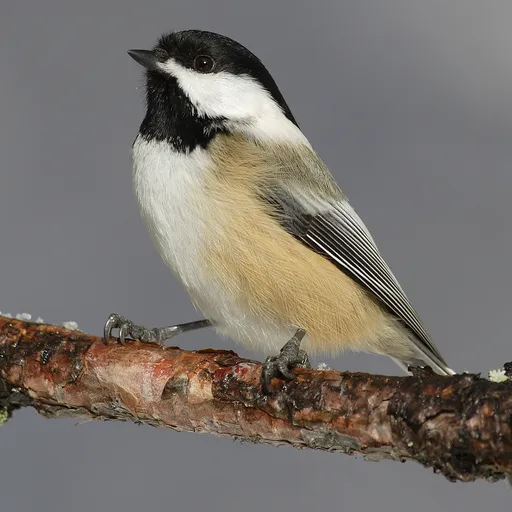
Black-capped Chickadee
Poecile atricapillus
Least Concern
Listen
XC935615 · Doug Hynes · Whitbourne, Newfoundland and Labrador, Canada · CC BY-SA 4.0
Overview
The black-capped chickadee is a small, non-migratory passerine bird native to North America that inhabits deciduous and mixed forests. It is widely distributed and considered a species of least concern by the IUCN, with populations that are currently increasing.
Identification
- Small body weighing 10–14 g with a distinctive black cap and bib, white cheeks, white underparts, and buff-coloured flanks.
- Unstreaked greenish-grey back and slate grey wings and tail, with a black beak and legs and dark brown irises.
- Recognised by a slow, hoarser two-note fee-bee song and a complex chick-a-dee-dee-dee alarm call, which distinguishes it from the similar Carolina chickadee.
- Males and females are similar in appearance, though males possess a larger bib.
Habitat
This species occupies wooded areas such as coniferous and deciduous forests, urban parks, willow thickets, and suburban areas across North America. Its range extends from western Alaska and the Yukon through Canadian provinces to the United States, where it is found from northern California and Nevada through the Midwest to New Jersey and the Appalachian Mountains.
Diet
The diet consists primarily of insects, especially caterpillars, in summer, with seeds, berries, insect eggs, and pupae becoming more important in winter. Foraging involves hopping along tree branches, hanging upside down, hovering, and catching insects in the air, as well as taking sunflower seeds from feeders and gnawing fat from dead mammals.
Did you know?
The hippocampus of the black-capped chickadee grows during the caching season to aid in remembering food locations, and the bird can lower its body temperature at night to conserve energy in cold winters.
Sources
- Wikipedia · CC BY-SA 4.0
- Wikidata · CC0 1.0