
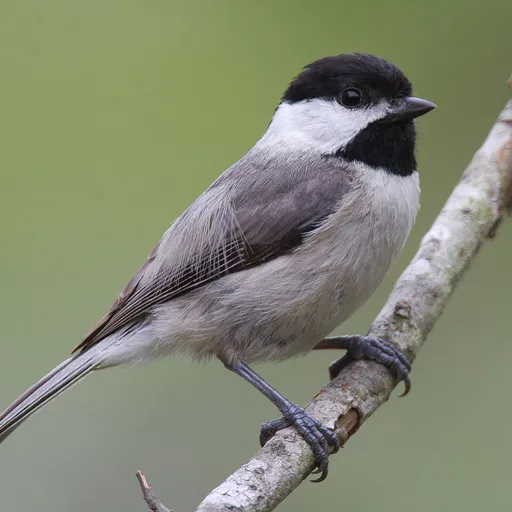
Carolina Chickadee
Poecile carolinensis
Least Concern
Listen
XC870687 · steve · Chapel Hill, Orange County, North Carolina, United States · CC BY-SA 4.0
Overview
The Carolina chickadee (Poecile carolinensis) is a small passerine bird in the tit family Paridae, largely found in the Southern United States. It is closely related to the black-capped chickadee, with which it can hybridise where their ranges overlap, though their offspring typically suffer from lower hatching success.
Identification
- Adults measure 10–12 cm in length and have a black cap and bib with white sides to the face, white underparts with rusty brown flanks, and a gray back.
- Distinguished from the black-capped chickadee by slightly browner wings with brown greater coverts (rather than whitish fringed), less conspicuous white fringing on secondary feathers, and a slightly shorter, more square-ended tail.
- The chick-a-dee call is faster and higher-pitched than that of the black-capped chickadee, and its song consists of a four-note fee-bee-fee-bay melody.
- Visual distinction between the two species is extremely difficult even with an excellent view, making vocal cues essential for field identification.
Habitat
Breeding habitat consists of mixed or deciduous forests across the United States, ranging from New Jersey and Pennsylvania west to southern Kansas and south to Florida and Texas, with a gap at high altitudes in the Appalachian Mountains where the black-capped chickadee predominates. They are permanent residents that do not usually migrate even in severe winter weather, though they may flock with other species during the colder months.
Diet
Carolina chickadees forage by hopping along tree branches to search for insects, sometimes hanging upside down or hovering, and making short flights to catch insects in the air. Insects form a large part of their diet in summer, while seeds and berries become more important in winter. They sometimes hammer seeds on trees or shrubs to open them, store seeds for later use, and commonly visit bird feeders, often carrying seeds to isolated branches to eat.
Did you know?
During extremely cold winters, Carolina chickadees can lower their body temperature to enter a state of torpor, spending up to fifteen hours at a time in cavities where they remain awake but unresponsive; they should not be handled during this state, as the stress of being held may cause death.
Sources
- Wikipedia · CC BY-SA 4.0
- Wikidata · CC0 1.0