
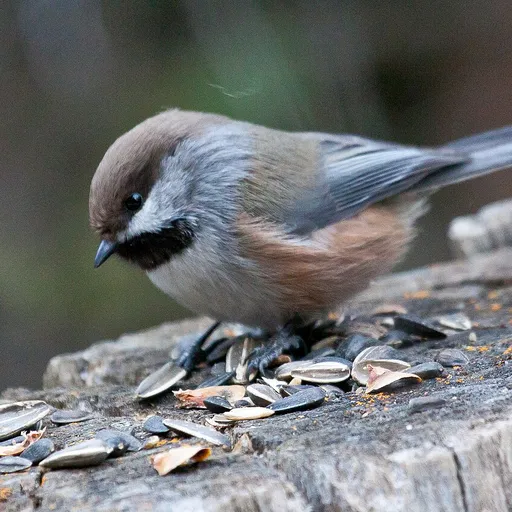
Boreal Chickadee
Poecile hudsonicus
Least Concern
Listen
XC1103706 · Doug Hynes · Qame'k (Seal Island), Kespukwitk, Nova Scotia, Canada · CC BY-SA 4.0
Overview
The boreal chickadee (Poecile hudsonicus) is a small passerine songbird belonging to the tit family Paridae. It is classified as Least Concern on the IUCN Red List and is found in the boreal forests of Alaska, Canada, and the northern United States, where it generally remains resident throughout the year.
Identification
- Measures 12.5–14.5 cm in length and weighs between 7–12.4 g, featuring grey-brown upperparts, a brown cap, and greyish wings and tail.
- Has a mainly grey face with white sides, white underparts with brown flanks, and a distinct black throat.
- Possesses a short dark bill, short wings, and a long notched tail.
- Emits a husky 'tsee-day-day' call and a high-pitched trill known as 'dididididididi'.
Habitat
This species inhabits coniferous woods in Canada, Alaska, and the northernmost portions of the contiguous United States. Breeding typically occurs from early May to late August, with the pair remaining together year-round, though winter movements south have become increasingly rare. Large bodies of water and mountain ranges can restrict dispersal to isolated areas such as the Vancouver Islands and Haida Gwaii.
Diet
Boreal chickadees forage on conifer branches and probe into bark to glean insects and collect conifer seeds, primarily in black spruce, white spruce, and tamarack trees. They store large amounts of food in the mid-regions of trees for winter, often foraging in small flocks with other small birds during the colder months.
Did you know?
Females are more attracted to male chickadees that display complex and larger song repertoires, as these traits can convey the male's rank to neighbouring fertile females. Additionally, the species stores food in different trees at a lower level than the height at which they foraged, demonstrating sophisticated spatial memory.
Sources
- Wikipedia · CC BY-SA 4.0
- Wikidata · CC0 1.0