
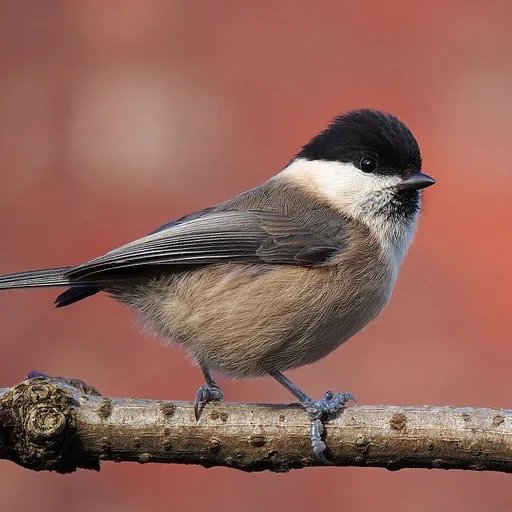
Willow Tit
Poecile montanus
Least Concern
Listen
XC1043552 · Christian Kahle · Schneverdingen, Germany · CC0 1.0
Overview
The willow tit (Poecile montanus) is a passerine bird in the tit family, Paridae, characterised as a widespread and common resident breeder throughout temperate and subarctic Europe and across the Palearctic. It is considered more of a conifer specialist than the closely related marsh tit, which facilitates its breeding much farther north. Most individuals do not migrate and remain resident in their territories.
Identification
- Size and structure: 11.5 cm in length with a wingspan of 17–20.5 cm, featuring a large head and a thin bill.
- Plumage: Grey-brown and off-white body with a long, dull black cap that descends to the mantle and a black bib; the sides of the face are white, the back is grey-brown, and the underparts are buff.
- Distinguishing features: Distinguished from the marsh tit by a sooty brown rather than glossy blue-black cap, more buff underparts, and rufous flanks; pale buff edgings to the secondaries form a light patch on the closed wing.
- Voice: The commonest call is a nasal "zee, zee, zee", though notes vary, and it occasionally repeats a double note, "ipsee, ipsee", four or five times.
Habitat
The willow tit is found throughout temperate and subarctic Europe and across the Palearctic, with an estimated population of between 175 and 253 million mature individuals. It is a resident species where most birds do not migrate, and it is more of a conifer specialist than the marsh tit, explaining its breeding range much farther north. The species is classed as of least concern by the IUCN, although the population in the United Kingdom declined by 83% between 1995 and 2017 due to habitat loss and competition.
Diet
Birds feed on insects, caterpillars, and seeds, much like other tits. The species is parasitised by the moorhen flea, Dasypsyllus gallinulae.
Did you know?
The willow tit excavates its own nesting hole by piercing hard bark, usually in a rotten stump or a more or less decayed tree. In the United Kingdom, the species' population declined by 83% between 1995 and 2017, a rapid decrease believed to be caused by habitat loss, competition for nest holes by other tits such as blue tits, and nest predation by the great spotted woodpecker.
Sources
- Wikipedia · CC BY-SA 4.0
- Wikidata · CC0 1.0