
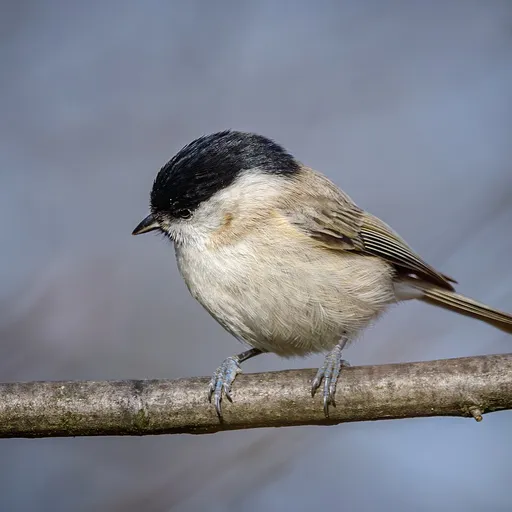
Marsh Tit
Poecile palustris
Least Concern
Listen
XC707391 · Sonothèque ADVL · Carolles, Manche, Normandie, France · CC0 1.0
Overview
The marsh tit is a small Eurasian passerine bird in the tit family Paridae, closely related to the willow tit. It is a widespread and common resident breeder throughout temperate Europe and northern Asia, though numbers in the United Kingdom have declined significantly since the 1970s.
Identification
- Approximately 12 cm long and weighing 12 g, with a black crown and nape that often displays a blue sheen, pale cheeks, and a brown back.
- Wings and tail are greyish-brown, lacking the pale wing panel typical of the willow tit, with crisp, neat overall markings.
- Possesses a well-defined and wide song repertoire, including ringing 'schip-schip' notes and liquid 'tu-tu-tu' sounds, as well as an explosive 'pitchou' call when agitated.
- Best distinguished from the similar willow tit by its voice, smaller head proportion, glossier black cap, and the pale cutting edge of its bill.
Habitat
Found across temperate Europe and northern Asia, the species prefers large areas of moist, broadleaved woodland, often oak or beech, but can also occupy wet alder woodland, riverside trees, parks, and gardens. Marsh tits are sedentary and mostly stay within their breeding territories year-round, with young birds occasionally joining mixed roaming flocks. They require mature trees with a shrub layer below the canopy and avoid areas with many young trees or dense canopies lacking understorey cover.
Diet
This omnivorous species feeds primarily on spiders and insects in spring and summer, switching to seeds, nuts, and berries in autumn and winter, with beechmast being a preferred food when available. It forages by collecting and storing large numbers of seeds, often retrieving the oldest items first and memorising their locations rather than searching randomly. Marsh tits frequently take seeds and fruit from plants before moving to another location to consume them.
Did you know?
The marsh tit's hippocampus is 31% larger relative to body size than that of the great tit, a feature that supports its impressive ability to memorise the locations of cached food.
Sources
- Wikipedia · CC BY-SA 4.0
- Wikidata · CC0 1.0