
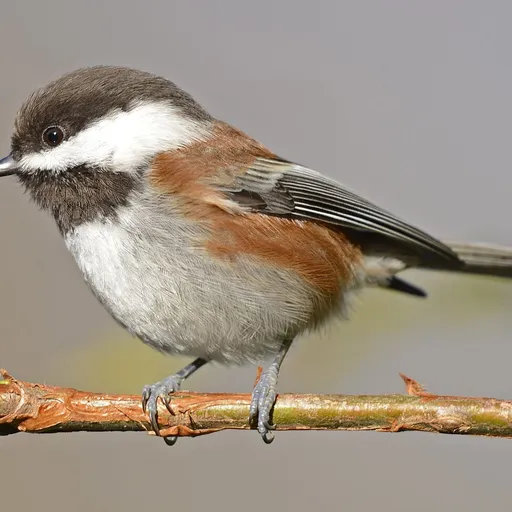
Chestnut-backed Chickadee
Poecile rufescens
Least Concern
Overview
The chestnut-backed chickadee (Poecile rufescens) is a small passerine bird in the tit family, native to western North America. It is considered the most vibrant of all chickadees, characterized by its rich rufous-brown plumage.
Identification
- Small size, measuring 11.5–12.5 cm (4.5–4.9 in) long with a weight of 8.5–12.6 g (0.30–0.44 oz).
- Dark blackish-brown head with white cheeks and a bright rufous-brown mantle.
- Wings are dark gray with paler fringes, and underparts are white to pale grayish-white with rufous or pale gray flanks.
- Identified by a “chick-a-dee” call with the “dee” repeated a few times, and adults may emit a hissing noise to mimic a snake.
Habitat
Found in the Pacific Northwest of the United States and western Canada, ranging from southeastern Alaska to southwestern California. It inhabits low-elevation coniferous and mixed coniferous forests, consisting mainly of Douglas fir, western hemlock, and western redcedar. In the San Francisco Bay Area, the species has adapted to suburban settings, utilising planted trees and shrubs that resemble its natural forest habitat.
Diet
Feeds largely on insects and other invertebrates gleaned from foliage, especially that of the Douglas fir, as well as seeds, plant matter, and fruit. They often move through the forest in mixed feeding flocks with species such as bushtits, warblers, red-breasted nuthatches, and kinglets. The bird visits bird feeders, including hummingbird feeders, and has a particular preference for suet.
Did you know?
Chestnut-backed chickadees can use nocturnal hypothermia to regulate energy expenditure, conserving up to 32% of their energy to survive harsh winters where other bird species might not. Their nests are composed of approximately 50% fur and hair, commonly sourced from deer, rabbits, and coyotes.
Sources
- Wikipedia · CC BY-SA 4.0
- Wikidata · CC0 1.0