
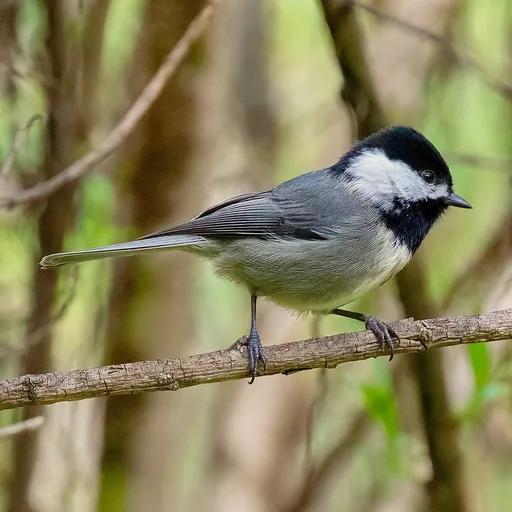
Mexican Chickadee
Poecile sclateri
Least Concern
Overview
The Poecile sclateri is a small passerine songbird in the family Paridae found in Mexico and the U.S. states of Arizona and New Mexico. It is currently classified as Least Concern by the IUCN, although its estimated population of two million mature individuals is believed to be decreasing.
Identification
- Approximately 13 cm long and weighing between 9 and 12 g.
- Features a black head with a faint bluish gloss, pure black cheeks, chin, and throat that extend onto the upper breast, contrasting with a white face.
- Back, scapulars, and rump are deep olive or mouse gray, while wings and tail are slate gray.
- Song consists of short, abrupt phrases described as 'peeta peeta peeta', accompanied by high, buzzy calls.
Habitat
This species inhabits pine, pine-oak, and spruce/fir forests in subtropical and tropical zones between 1,500 and 3,900 m elevation. In the U.S., it primarily occurs in coniferous forests above 2,100 m during breeding, whereas in Mexico, it is most common above 2,200 m across all three forest types.
Diet
It feeds mostly on adult and larval insects, gleaning food from leaves and twigs throughout conifers and on the periphery of deciduous trees. Foraging involves hanging upside down or briefly hovering, and in winter, the bird commonly joins mixed-species feeding flocks of up to 100 members.
Did you know?
Uniquely for any species in the family Paridae, it has been recorded applying crushed toxic beetles to the outside of the nest hole, presumably to deter potential predators.
Sources
- Wikipedia · CC BY-SA 4.0
- Wikidata · CC0 1.0