
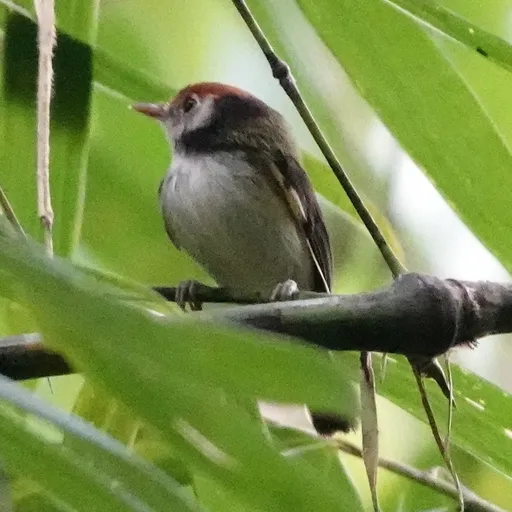
White-cheeked Tody-Flycatcher
Poecilotriccus albifacies
Least Concern
Overview
The white-cheeked tody-flycatcher (Poecilotriccus albifacies) is a small passerine bird in the family Tyrannidae, classified as Least Concern by the IUCN Red List. It is a year-round resident found in the forests of southern Peru, western Brazil, and far northwestern Bolivia.
Identification
- Adults are approximately 9.5 cm long and weigh about 8 g.
- Males feature a rufous crown and black nape that thin under the cheeks, a white face, olive back, and white underparts with streaky black breast sides.
- Females are duller with dark gray neck and cheeks, and have wide olive edges on the flight feathers.
- Both sexes have a brown iris, a black maxilla, an orange-yellow mandible, and gray legs.
- The song consists of a slightly rising series of rich, deep notes described as 'turp-ip-ip-ip ip ip ip'.
Habitat
Found in southern Madre de Dios and northeastern Cuzco in Peru, western Brazil's Acre state, and far northwestern Bolivia. The species inhabits humid tropical transitional forest, almost exclusively within dense thickets of Guadua bamboo at elevations reaching up to 1,050 m.
Diet
This insectivorous bird forages in pairs, typically between 2 and 9 m above the ground within bamboo thickets or nearby vine tangles. It obtains prey by gleaning from foliage and branches while perched, or by making short upward or forward sallies, and does not join mixed-species feeding flocks.
Did you know?
The species was originally described in 1959 as Todirostrum albifacies and was considered closely related to the black-and-white tody-flycatcher, with the two treated as conspecific for a period during the twentieth century before being separated and moved to the genus Poecilotriccus.
Sources
- Wikipedia · CC BY-SA 4.0
- Wikidata · CC0 1.0