
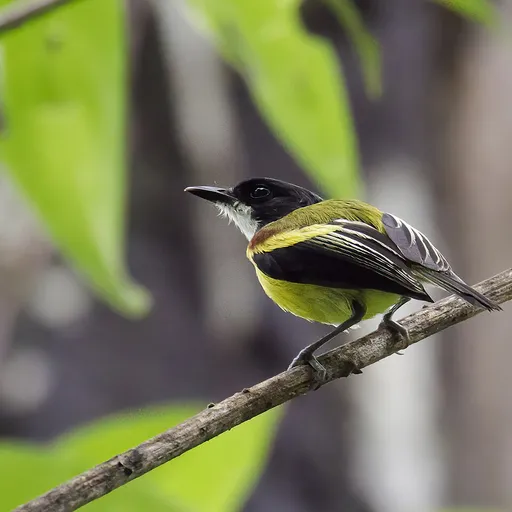
Golden-winged Tody-Flycatcher
Poecilotriccus calopterus
Least Concern
Listen
XC249462 · Niels Krabbe · Napo: 1 km S Puerto Napo, Ecuador · CC BY-SA 4.0
Overview
The Poecilotriccus calopterus, or golden-winged tody-flycatcher, is a small bird belonging to the tyrant flycatcher family. Classified as a species of Least Concern, it is a year-round resident found in South America, though its population is believed to be decreasing.
Identification
- Approximately 9.5 cm long and weighing about 6 g, with uniform plumage in both sexes.
- Features a mostly black head with a white throat, an olive-green back, and a black tail.
- Displays bright yellow breast and belly, with black wings marked by yellowish-white edges, chestnut lesser coverts, and bright yellow median coverts forming two wing bars.
- Possesses a black bill, brown iris, and blue-gray legs and feet.
Habitat
Found on the east slope of the Andes from southern Colombia through Ecuador to northern Peru, this species inhabits dense shrubby vegetation at the edges and in clearings of humid evergreen forests. It also occupies overgrown fields and gardens at elevations ranging from 300 to 1,300 m depending on the country.
Diet
This insectivore typically forages in pairs within dense vegetation close to the ground, avoiding mixed-species flocks. It primarily captures prey from foliage using short upward sallies from a perch, occasionally hovering briefly after a short flight.
Did you know?
Despite the limited data on its breeding biology, the species may be increasing in abundance or expanding its range in the lowlands as a response to agricultural clearing, which creates the dense understory tangles it prefers.
Sources
- Wikipedia · CC BY-SA 4.0
- Wikidata · CC0 1.0