
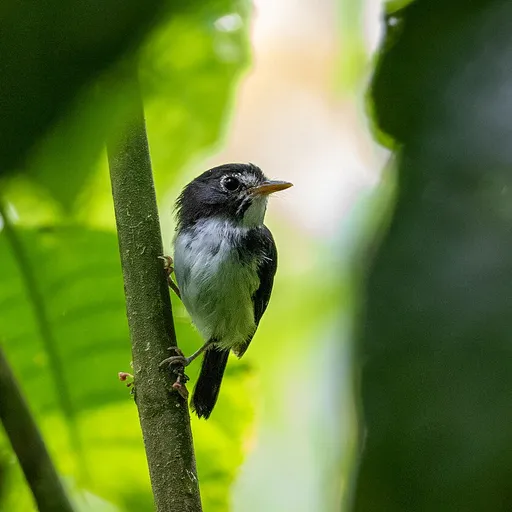
Black-and-white Tody-Flycatcher
Poecilotriccus capitalis
Least Concern
Listen
XC251408 · Niels Krabbe · Zamora-Chinchipe: 'Cabañas Yankuam' 2 km S Las Orchideas, Nangaritza Valley, Ecuador · CC BY-SA 4.0
Overview
The black-and-white tody-flycatcher (Poecilotriccus capitalis) is a small bird in the tyrant flycatcher family, native to South America. It is classified as a species of Least Concern by the IUCN, though its population is believed to be decreasing. This species is monotypic and found in a highly disjunct distribution across parts of Colombia, Ecuador, Peru, and Brazil.
Identification
- Size: Approximately 9 to 9.5 cm (3.5 to 3.7 in) in length, weighing between 5.6 and 8 g.
- Plumage: Adult males feature glossy black heads and upperparts with white lores and eye-rings, while females have chestnut crowns and buffy lores. Underparts are mostly white, often with black streaks on the breast sides and a pale yellow tinge on the flanks. Both sexes possess reddish-brown irises and black-and-white facial markings.
- Bill and Legs: The bill has a black maxilla and a pale orange-yellow mandible; legs and feet are grey.
- Song: The call is described as a fast, sharp 'tik, t-r-r-r-r-r-r-ew', changing to a more explosive 'tk, tk, tk, whey-whey-whey-whuh' when agitated.
Habitat
This species inhabits the edges of lowland and foothill terra firme forests, as well as areas along roads and small watercourses, strongly favouring viny tangles and bamboo stands. Its range is highly disjunct, covering southern Colombia, Ecuador, parts of Peru, and isolated pockets in Brazilian states such as Amazonas, Rondônia, and Mato Grosso. Elevations typically range between 250 and 1,350 m.
Diet
The black-and-white tody-flycatcher feeds on insects, typically foraging alone or in pairs near the ground within dense vegetation. It captures prey from foliage using short upward or forward sallies from a perch and is known in Colombia and Peru to join mixed-species feeding flocks.
Did you know?
The species was originally described in 1857 as Todirostrum capitale and was known for much of the twentieth century as the black-and-white tody-tyrant. It was renamed a flycatcher in the early twenty-first century after taxonomic systems began standardising the names of the genus Poecilotriccus.
Sources
- Wikipedia · CC BY-SA 4.0
- Wikidata · CC0 1.0