
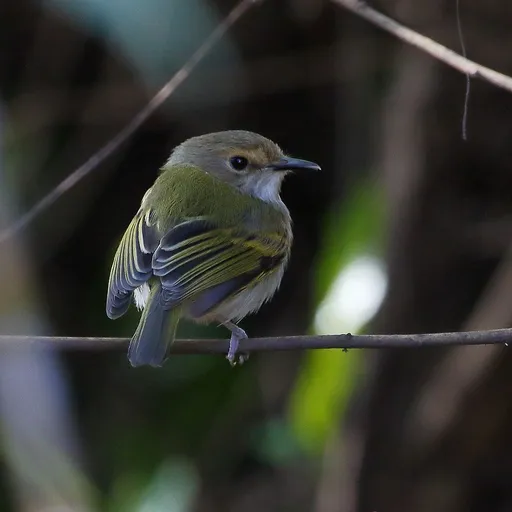
Rusty-fronted Tody-Flycatcher
Poecilotriccus latirostris
Least Concern
Listen
XC249590 · Niels Krabbe · Pastaza: Canelos, Ecuador · CC BY-SA 4.0
Overview
The rusty-fronted tody-flycatcher (Poecilotriccus latirostris) is a species of tyrant flycatcher found in South America. It is assessed as Least Concern by the IUCN, with a very large range and a population believed to be stable.
Identification
- Length of 9 to 9.5 cm with a weight of approximately 7 to 9 g.
- Brownish gray crown and olive back, contrasting with a rusty-buff forecrown and face that are brightest around the lores and eyes.
- Dusky wings featuring two distinct wing bars formed by ochraceous tips on the coverts and narrow yellowish edges on the flight feathers.
- Song consists of an easily overlooked, low-pitched, insect-like descending trill, often described as a rich 'tchur'r'r'r'r'r' or a rattled 'tik, trrrr'.
Habitat
Found in Bolivia, Brazil, Colombia, Ecuador, Paraguay, and Peru, inhabiting low, dense vegetation along river edges, secondary forest, and gallery forest. It also occurs in shrubby clearings within forests and on river islands, reaching elevations up to 1,200 m in Colombia.
Diet
This species feeds on insects, typically foraging singly or in pairs within about 1 m above the ground, though it will ascend to 3.5 m along vine-covered tree trunks. It primarily takes prey from foliage using short sallies from a perch and rarely joins mixed-species feeding flocks.
Did you know?
Although human activity has little direct effect on the species, the rusty-fronted tody-flycatcher may actually benefit from habitat disturbance in the short term because it occupies second growth and forest edges rather than primary closed-canopy forest.
Sources
- Wikipedia · CC BY-SA 4.0
- Wikidata · CC0 1.0