
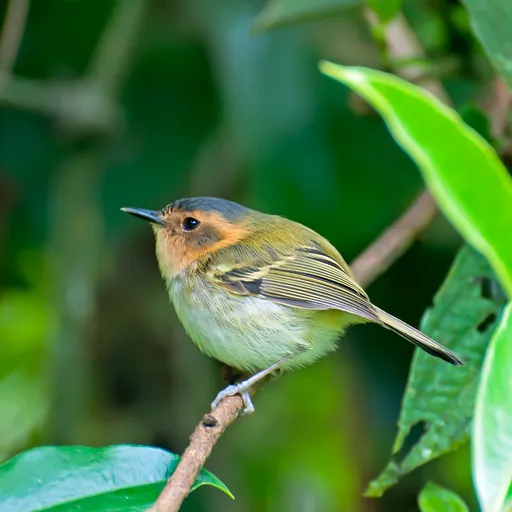
Ochre-faced Tody-Flycatcher
Poecilotriccus plumbeiceps
Least Concern
Overview
The ochre-faced tody-flycatcher (Poecilotriccus plumbeiceps) is a small bird in the family Tyrannidae found across parts of South America, including Argentina, Bolivia, Brazil, Paraguay, Peru, and Uruguay. It is classified as Least Concern on the IUCN Red List, though its population is believed to be decreasing.
Identification
- Adults measure 9 to 10 cm in length and weigh between 5.3 and 6 g.
- The nominate subspecies features a buffish cinnamon forehead and face with a gray crown, dark olive back, and grayish white underparts.
- Wings are dusky with two distinct wing bars, and the tail is dark olive.
- The song in Peru is described as a deep, rich sputtering trill, while calls consist of a quiet rich tchup.
Habitat
This species inhabits the edges of humid forest and dense undergrowth in secondary forest, favouring areas with dense vine tangles, Chusquea bamboo, and Pteridium bracken. Its distribution is disjunct across the eastern slopes of the Andes and parts of the Atlantic Forest region, extending from Peru and Bolivia south into Argentina, Paraguay, Brazil, and Uruguay.
Diet
The ochre-faced tody-flycatcher feeds primarily on insects, foraging in pairs and very seldom joining mixed-species flocks. It typically forages in dense vegetation, taking prey from foliage close to the ground using short sallies from a perch.
Did you know?
The species was first documented in Uruguay in 1997, with subsequent confirmations in 1999 and 2006. Its nest is a messy pear-shaped ball suspended from branch tips, which is often targeted by brood parasitism from the pavonine cuckoo.
Sources
- Wikipedia · CC BY-SA 4.0
- Wikidata · CC0 1.0