
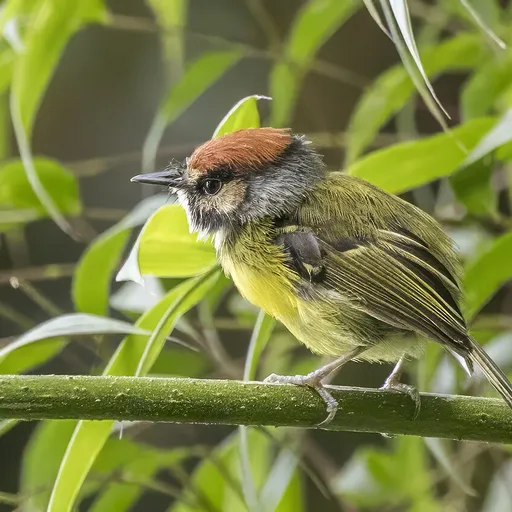
Rufous-crowned Tody-Flycatcher
Poecilotriccus ruficeps
Least Concern
Listen
XC248933 · Niels Krabbe · Napo: pass of Cord. de los Guacamayos, Ecuador · CC BY-SA 4.0
Overview
The rufous-crowned tody-flycatcher, Poecilotriccus ruficeps, is a small bird in the tyrant flycatcher family found across parts of northern South America. It is currently assessed as a species of Least Concern by the IUCN, though its population is believed to be decreasing due to habitat loss.
Identification
- About 9 to 10 cm long and weighing approximately 6.6 g, with identical plumage in both sexes.
- Features a bright rufous crown and grey nape separated by a black line that extends onto the cheek, alongside white to buffy cheeks and an olive back.
- Underparts are bright yellow on the belly, with a buffy whitish throat and upper breast marked by a faint dusky or blackish band.
- Song is a sputtering "pa-treer-pít-pít-pít" and calls include gravelly sounds like "tttrew" or "pit-tttrew", often given as a duet.
Habitat
This species inhabits shrubby and brushy areas at the edges and in clearings of primary and secondary forest, overgrown pastures, and along watercourses, roads, and bamboo stands, but avoids the forest interior. It is found at elevations between 1,500 m and 2,900 m across a disjunct range covering parts of Venezuela, Colombia, Ecuador, and Peru.
Diet
Feeds on insects foraged singly, in pairs, or in small family groups, though it rarely joins mixed-species flocks. It forages mostly near the ground in dense vegetation, taking prey with short upward or forward sallies from a perch to grab it from leaves.
Did you know?
The species was long known as the rufous-crowned tody-tyrant, but taxonomic systems began renaming such species to "flycatcher" by the early twenty-first century to resolve inconsistencies where the genus contained birds called both "tyrants" and "flycatchers".
Sources
- Wikipedia · CC BY-SA 4.0
- Wikidata · CC0 1.0