
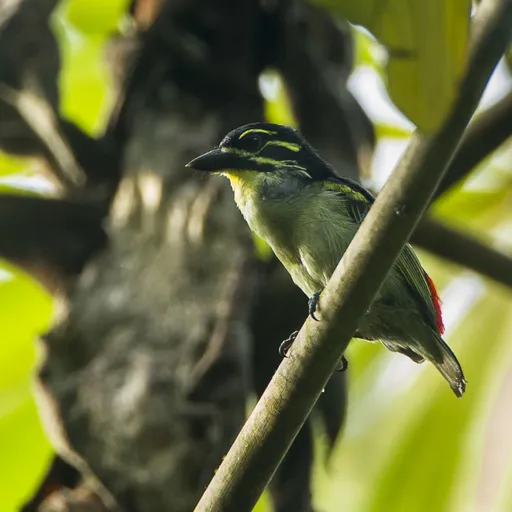
Red-rumped Tinkerbird
Pogoniulus atroflavus
Least Concern
Overview
The red-rumped tinkerbird, Pogoniulus atroflavus, is a small, monotypic bird species belonging to the Lybiidae family. It is classified as Least Concern on the IUCN Red List, although its global population is estimated at approximately 300,000 individuals and is currently declining.
Identification
- Body length of approximately 12–13 cm with a weight range of 14–21.5 g.
- Distinct plumage featuring a yellow chest, black head and back, and a red rump.
- Black wings with yellow-tipped feathers; younger individuals exhibit duller plumage and a yellowish bill.
- Vocalisations include an unbroken series of “pop” notes at roughly 1.3 per second, rapid “bdddddt” trills lasting 3–4 seconds, and shorter, higher-pitched trills.
Habitat
This species inhabits mangrove forests, forest clearings, plantations, and grasslands throughout mid-western Africa. It typically occupies elevations below 800 m, though in certain parts of West Africa it may be found up to 1,550 m.
Diet
The diet consists primarily of fruits, figs, and plants of the species Allophylus and Loranthus, alongside insects and spiders. Foraging occurs at all levels of the forest, with the species being most active in the canopy but also present on lower tree branches.
Did you know?
The species is sedentary with no seasonal migration, yet its breeding seasons vary widely by region, ranging from November to May in West Africa to June to February in Uganda.
Sources
- Wikipedia · CC BY-SA 4.0
- Wikidata · CC0 1.0