
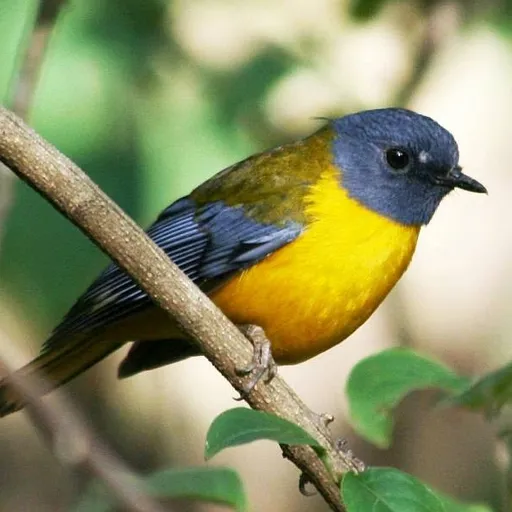
White-starred Robin
Pogonocichla stellata
Least Concern
Overview
The white-starred robin (Pogonocichla stellata) is a small, brightly coloured bird in the Old World flycatcher family, Muscicapidae. It is monotypic within its genus and found in forested areas of East and southern Africa.
Identification
- Small bird, 15 to 16 cm long, with a slate-grey head featuring distinctive white spots in front of the eyes and on the throat.
- Bright yellow breast and belly contrasting with moss-green or olive-green upperparts and bluish-grey wings.
- Broad black bill surrounded by well-developed rictal bristles, and pinkish legs.
- Song varies by subspecies, including quiet territorial ads and a courtship call rendered as a sustained "wiii wii wiii".
Habitat
Primarily found in primary or secondary moist evergreen forest with a good understory of shrubs and vines, though it also uses forest edges, pine and wattle plantations, and evergreen woodlands. Its range covers the Afromontane of sub-Saharan Africa, occurring at altitudes between 1,500 and 2,200 m in the north, but down to sea level in South Africa.
Diet
Feeds principally on insects and fruits, with dietary studies showing a predominance of beetles, moths, and ants, alongside spiders, flies, and caterpillars. It also consumes fruits from various species and has been recorded eating snails, termites, mantids, and small frogs.
Did you know?
The species is a partial migrant that undertakes altitudinal movement to lower elevations during the winter, and in Malawi, males have been observed to remain in their breeding territories while the females move away.
Sources
- Wikipedia · CC BY-SA 4.0
- Wikidata · CC0 1.0