
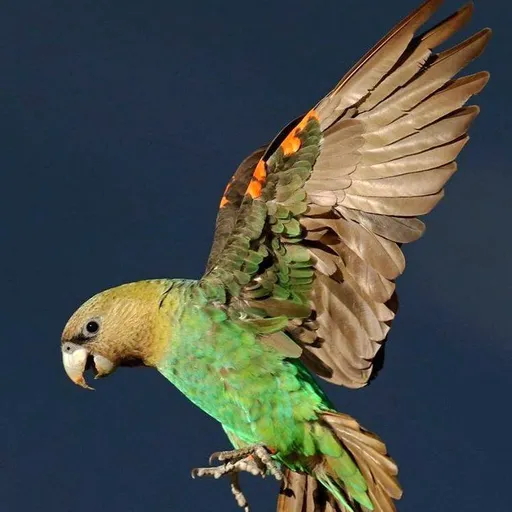
Cape Parrot
Poicephalus robustus
Vulnerable
Overview
The Cape parrot, also known as Levaillant's parrot, is a large, temperate forest-dwelling parrot endemic to South Africa. It is classified as Vulnerable on the IUCN Red List and was formerly considered a subspecies of the brown-necked parrot.
Identification
- A short-tailed, moderately large bird with a very large beak used for cracking hard nuts and fruit kernels.
- Females typically display an orange frontal patch on the forehead, which is also present but larger in juveniles.
- Exhibits a distinctive silhouette, a slow, 'rowing' flight pattern, and raucous calls.
- The species is smaller than the closely related brown-necked parrot and features an olive-yellow head rather than a silvery-grey one.
Habitat
The Cape parrot inhabits Afromontane forests at moderate altitudes in eastern South Africa, ranging from the coastal escarpment near sea level to midlands at approximately 1000 m. These forests are dominated by yellowwood trees (Podocarpus latifolius, Podocarpus falcatus, and Podocarpus henkelii) and occur in fragmented patches. The largest population is found in the Amathole mountains, extending east through the Mthatha escarpment and Pondoland to KwaZulu-Natal, with a small, isolated group in the Magoebaskloof area of Limpopo.
Diet
The bird feeds on hard nuts and fruit kernels, particularly those of African yellowwood trees (Podocarpus spp.). It possesses a very large beak specifically adapted to crack these tough food items.
Did you know?
A small trade in wild-caught Cape parrots persists despite international CITES restrictions, as they are highly regarded for their intelligence and are kept as cage birds. Over one hundred individuals are currently kept in captivity, most of which were wild-caught.
Sources
- Wikipedia · CC BY-SA 4.0
- Wikidata · CC0 1.0