
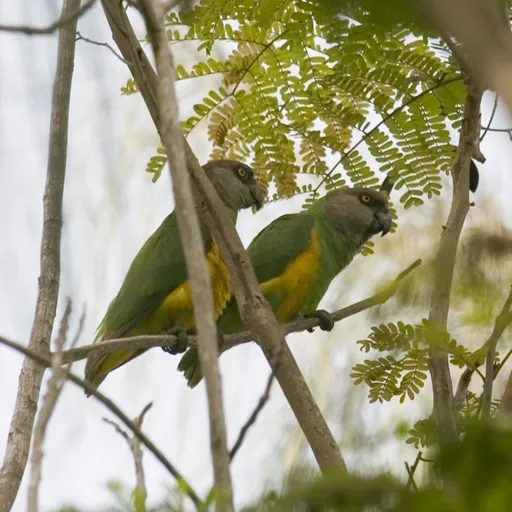
Senegal Parrot
Poicephalus senegalus
Least Concern
Overview
The Senegal parrot (Poicephalus senegalus) is a resident breeder across a wide range of West Africa, classified as Least Concern on the IUCN Red List. It is a gregarious species that makes migrations within its range based on the availability of food and is considered a farm pest in certain regions.
Identification
- Approximately 23 centimetres in length, featuring a relatively large head and beak with a short, broad tail.
- Adults possess a charcoal grey head, grey beak, bright yellow irises, and green backs and throats, with yellow underparts and rump.
- The yellow and green areas on the front form a V-shape resembling a yellow vest worn over green, with the vest colour varying between yellow and deep orange-red depending on the subspecies.
- Juveniles are distinguished by dark grey, almost black irises that later change to light grey.
Habitat
This species inhabits open woodland and savanna environments, flocking most commonly in countries across West Africa. Its range extends from Senegal, southern Mauritania, and southern Mali to Guinea and Lobos Island, with another subspecies ranging from Ivory Coast and Ghana east to western Nigeria.
Diet
The diet consists primarily of fruit (about 77%), seeds (about 22%), and flowers (1%), with figs, African grapes, and shea fruits being the most commonly eaten items. It is considered a farm pest in Africa, frequently feeding on crops such as maize and millet.
Did you know?
Senegal parrots are one of the most popular parrots kept as pets, but wild-caught individuals do not usually become tame and make poor companions. The nominate subspecies, which has a yellow vest, is the most common variety in the pet trade.
Sources
- Wikipedia · CC BY-SA 4.0
- Wikidata · CC0 1.0