
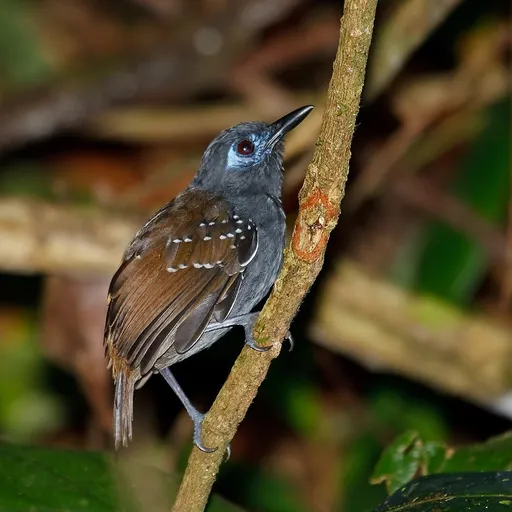
Chestnut-backed Antbird
Poliocrania exsul
Least Concern
Listen
XC958130 · Beth Cottam · Tres Equis, Turrialba, Provincia de Cartago, Costa Rica · CC0 1.0
Overview
The chestnut-backed antbird (Poliocrania exsul) is a passerine bird in the family Thamnophilidae. It is found across parts of Central America, including Colombia, Costa Rica, Ecuador, Honduras, Nicaragua, and Panama.
Identification
- 14 to 15 cm in length and approximately 29 g in weight, with a pale blue patch of bare skin around each eye.
- Adult males have a slate-black head and neck, deep chestnut upperparts, and blackish slate underparts; females have duller heads and brownish underparts.
- Both sexes possess a reddish brown iris, a black bill, and dark horn to blackish legs and feet.
- Song consists of 2–3 whistled notes paraphrased as 'come...here' or 'come...right...here', sometimes written as 'drink beer! or drink more beer!'
Habitat
Most subspecies inhabit the understorey of humid to wet evergreen forest, favouring dense vegetation, vine tangles, and the undergrowth of older gaps in both primary and secondary forests. Elevational range varies by region, generally up to 1,200 m in Honduras, Costa Rica, and Colombia, and locally up to 1,500 m in Ecuador.
Diet
Feeds primarily on insects and other arthropods, and also consumes small lizards and frogs. Pairs and family groups forage in dense vegetation on or near the ground, walking and making short flutter-flights to pick prey, and sometimes join mixed-species feeding flocks or attend army ant swarms.
Did you know?
The genus name Poliocrania is derived from the Ancient Greek words for 'ash-gray' and 'head' or 'skull', yet the bird is named for its deep chestnut back. Both parents incubate the clutch during the day, but the female alone takes charge at night.
Sources
- Wikipedia · CC BY-SA 4.0
- Wikidata · CC0 1.0