
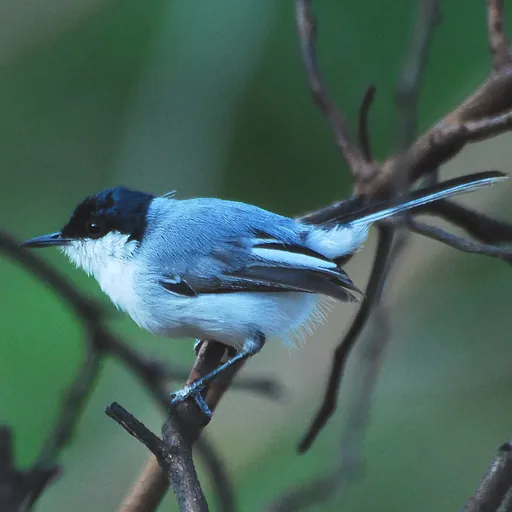
White-lored Gnatcatcher
Polioptila albiloris
Least Concern
Listen
XC541435 · Oliver Komar · San Antonio de Oriente, Francisco Morazán Department (Zamorano Univ. Finca Agroecológica), Honduras · CC BY-SA 4.0
Overview
The white-lored gnatcatcher (Polioptila albiloris) is a small passerine bird in the family Polioptilidae. It is classified as Least Concern by the IUCN and is native to Central America, specifically found in Costa Rica, El Salvador, Guatemala, Honduras, Mexico, and Nicaragua.
Identification
- Size: 11 to 12 cm long, weighing 6 to 9 g.
- Plumage: Nominate breeding males have a black cap extending to the eyes and nape, bluish-gray upperparts, and a white throat fading to pale bluish-gray on the breast and flanks; the tail is black with white outermost feathers.
- Markings: Females possess a dark gray cap and distinct white lores and supercilia; the P. a. vanrossemi male subspecies features a larger black cap and longer wings and tail than the nominate form.
- Juveniles: Similar to females but with browner upperparts.
Habitat
This species inhabits arid to semi-arid biomes, including scrublands, thorn forest, deciduous woodland, and secondary forest, while avoiding the interior of tall woodlands. It is mostly found below 1,000 m elevation, with the nominate subspecies ranging from central Guatemala through Central America into northwestern Costa Rica, and the P. a. vanrossemi subspecies found in southern Mexico.
Diet
The diet consists of a variety of adult insects, caterpillars, and spiders. Foraging behaviour is primarily gleaning, though the bird also makes sallies to catch flying insects.
Did you know?
The nesting season, which runs from March to August, is characterised by the construction of deep cup nests made of grass and roots that are specifically held together with spider silk.
Sources
- Wikipedia · CC BY-SA 4.0
- Wikidata · CC0 1.0