
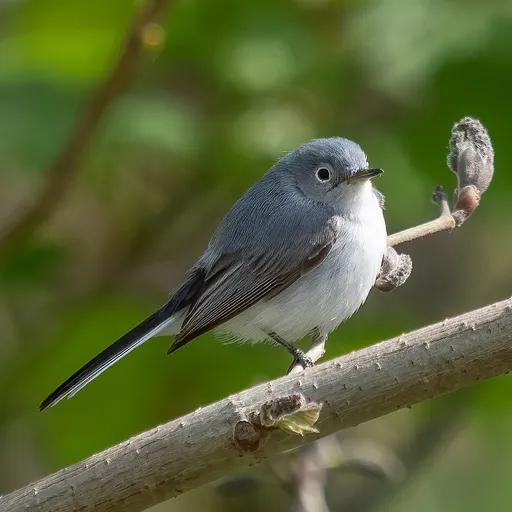
Blue-grey Gnatcatcher
Polioptila caerulea
Least Concern
Listen
XC796024 · steve · Crabtree Creek Trail access (near Raleigh), Wake County, North Carolina, United States · CC BY-SA 4.0
Overview
The blue-grey gnatcatcher (Polioptila caerulea) is a very small gnatcatcher native to North America. It is classified as Least Concern on the IUCN Red List and is the only gnatcatcher species that breeds in Eastern North America.
Identification
- Size: Very small, measuring 10–13 cm in length with a 16 cm wingspan and weighing only 5–7 g.
- Plumage: Males feature blue-grey upperparts and white underparts; females are less blue, while juveniles appear greenish-grey.
- Markings: Both sexes possess a white eye ring and a long black tail edged in white.
- Vocalisation: Calls sound like "zkreee, zkreee, zkreee", while songs include phrases like "szpree zpree spreeeeey".
Habitat
Breeding habitats include open deciduous woods and shrublands in southern Ontario, the eastern and southwestern United States, and Mexico. The species prefers humid areas with large leaves, woodlands, and open sandy areas with sparse trees. Non-breeding ranges extend to the southern United States, Mexico, northern Central America, Cuba, the Bahamas, the Turks and Caicos Islands, and the Cayman Islands.
Diet
Primarily eats insects, insect eggs, and spiders. Foraging methods include gleaning, where the bird hovers over foliage to snatch prey, and hawking, where it flies to catch insects in flight. The tail is often held upright while defending territory or searching for food.
Did you know?
Males frequently work to build nests, help with incubation, raise the young, and feed the children. The nest is constructed far out on a horizontal tree branch and is held together by spider silks and lichen plants.
Sources
- Wikipedia · CC BY-SA 4.0
- Wikidata · CC0 1.0