
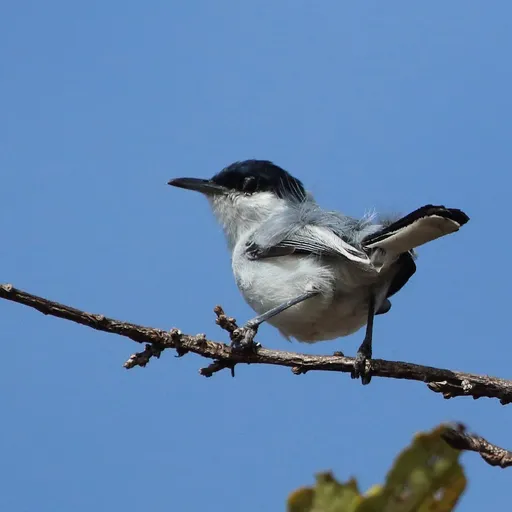
Tropical Gnatcatcher
Polioptila plumbea
Least Concern
Listen
XC784990 · Rosa Elena Albornoz · No Urbana Canoabo (near Palmicha), Bejuma, Carabobo, Venezuela · CC0 1.0
Overview
The tropical gnatcatcher (Polioptila plumbea) is a small, active insectivorous songbird that is a resident species throughout a large part of northern South America. Previously considered conspecific with the white-browed and Marañón gnatcatchers, it is now classified as one of 17 species within the genus Polioptila.
Identification
- Measures 10 to 12 cm in length and weighs 6 to 8 g, with a relatively long thin bill and a long, frequently cocked tail.
- Features grey upperparts and whitish underparts, with central tail feathers that are black and outer feathers that are white, creating a primarily black appearance from above.
- Males typically possess a contrasting black cap extending just below the eye, while females have a grey cap matching the back, though some may exhibit an irregular black post-ocular patch.
- Vocalisations include a thin buzzy 'gezzz' call and a trilled 'swee see see si si si su su' song, though tone and structure vary significantly across its range.
Habitat
Found in a wide range of wooded habitats, from arid woodland and scrub such as the Caatinga in Brazil to humid Amazonian forests, primarily in lowlands below 1,000 m. In dense humid forests, it typically occupies the canopy, whereas in more open habitats it is commonly seen at lower levels. Its distribution spans from northern Colombia and Venezuela through the Guianas and the Amazon Basin to northeastern Brazil, with related groups extending into Central America and northern South America.
Diet
Forages alone or in pairs, often joining mixed-species feeding flocks with tanagers, New World warblers, and honeycreepers. It gleans spiders, their eggs, beetles, caterpillars, and other insects from outer twigs and foliage.
Did you know?
This bird is curious and unafraid of humans, a behaviour that unfortunately renders it vulnerable to predators such as common marmosets, which eagerly plunder its nests despite the birds' attempts to defend their offspring.
Sources
- Wikipedia · CC BY-SA 4.0
- Wikidata · CC0 1.0