
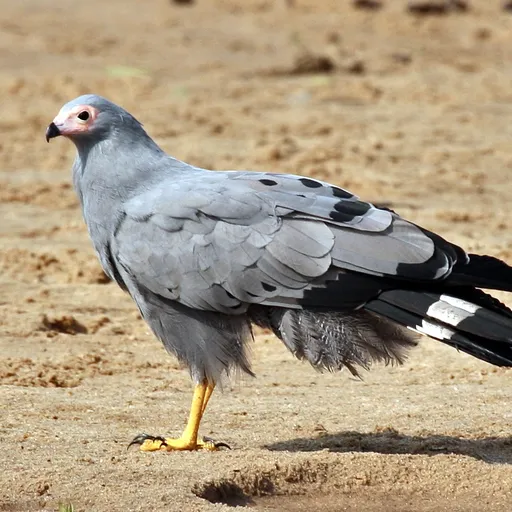
African Harrier-Hawk
Polyboroides typus
Least Concern
Overview
The African harrier-hawk, also known as the harrier hawk or gymnogene (Polyboroides typus), is a medium-sized bird of prey found across most of sub-Saharan Africa. It is a common raptor that is particularly prevalent in the tropical regions of western Africa but becomes less common in the east and south of the continent.
Identification
- Upperparts, head, and breast are pale grey, with a white belly featuring fine dark barring.
- Wings are broad and pale grey with a black trailing edge fringed by a narrow white line, and the tail is black with a single broad white band.
- Possesses a bare facial patch that is variable in colour, usually red or yellow.
- Call consists of a whistled 'sueee-sueee-sueee'.
Habitat
Breeds in most of Africa south of the Sahara, with highest densities in the tropical regions of western Africa. The species is highly adaptable, occupying thick rainforest, forest edges, riparian areas, agricultural land, and human-occupied zones, including urban gardens where they may breed in palm trees.
Diet
This omnivorous bird eats the fruit of the oil palm as well as small vertebrates, including introduced species such as feral pigeons, house sparrows, and eastern gray squirrels. It is known for raiding the nests of cavity-nesters like barbets and woodhoopoes to feed on eggs and nestlings.
Did you know?
The species possesses an unusual double-jointed ankle structure that enables it to reach into otherwise inaccessible holes and cracks to find prey. This unique limb structure represents a case of convergent evolution with the Neotropical crane hawk and the extinct Australian Pengana.
Sources
- Wikipedia · CC BY-SA 4.0
- Wikidata · CC0 1.0