
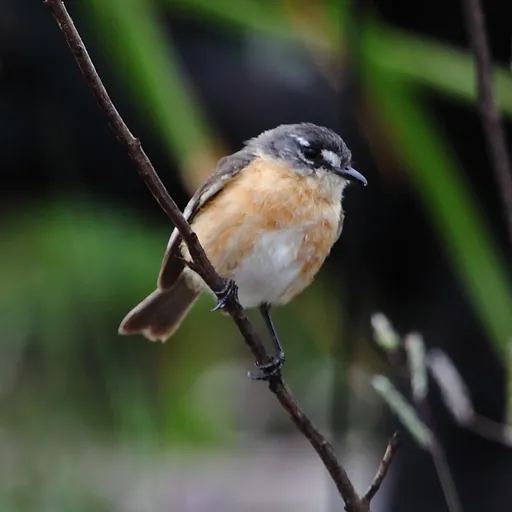
Grey-backed Tachuri
Polystictus superciliaris
Least Concern
Overview
The grey-backed tachuri (Polystictus superciliaris) is a small tyrant flycatcher endemic to Brazil. It is a monotypic species that is currently classified as Least Concern by the IUCN, despite a believed decreasing population.
Identification
- Measures 9.5 to 10 cm in length and weighs approximately 6 grams, with a grey crown and a short crest that partially hides a white centre.
- Upperparts are brownish grey with dark dusky wings featuring two pale wing bars, while underparts are pinkish buff fading to white on the lower belly.
- Distinctive facial markings include a short white supercilium, a white eye-ring, and a thin blackish line through the eye, set against a thinly black-and-white striped face.
- Song consists of a nervous, sustained 'tititi---' interrupted by a toneless 'purrrrr' trill, accompanied by a call of thin, compact 'eeh-uk' notes.
Habitat
Found in a disjunct distribution in eastern Brazil, primarily inhabiting campos rupestres, a rocky grassland biome with scattered shrubs. It also occupies brushy deserted pastures and, at higher elevations, grasslands and brushy edges of cloudforest, typically ranging from 900 to 2,300 m in elevation.
Diet
Feeds mostly on insects, foraging usually singly or in small groups of two or three. It perches high in grass or shrubs to glean from the perch, or makes short flights just above the vegetation to hover-glean or move to another perch.
Did you know?
The species' conservation status has fluctuated significantly, having been assessed as Threatened in 1988 and Near Threatened in 2004 before being downgraded to Least Concern in 2011 after its range was found to be larger than previously thought.
Sources
- Wikipedia · CC BY-SA 4.0
- Wikidata · CC0 1.0