
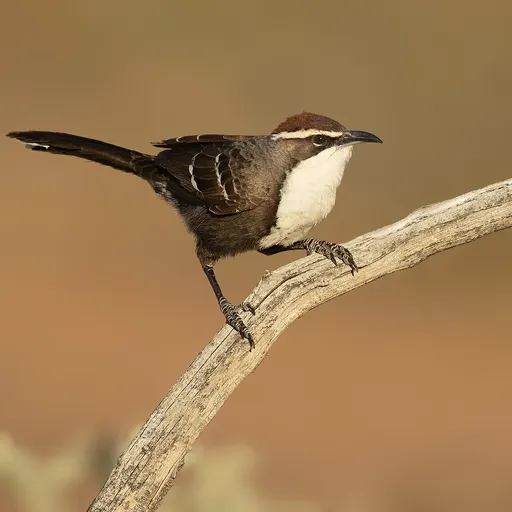
Chestnut-crowned Babbler
Pomatostomus ruficeps
Least Concern
Overview
The chestnut-crowned babbler (Pomatostomus ruficeps) is a medium-sized bird endemic to the arid and semi-arid regions of south-eastern Australia. As a member of the family Pomatostomidae, it is characterised by its boisterous, highly social nature, living in cohesive groups of up to 23 individuals that forage and breed communally.
Identification
- Dark brown-grey body with a rich chestnut crown, long white eyebrows, and white throat and breast.
- Features two white wing bars, a long, black, down-curved bill, grey legs, and dark brown eyes.
- Measures 21–23 cm in length and weighs approximately 50 g, appearing slimmer than other babbler species.
- Vocalisations include a strident, irregular territorial song resembling the piping of a little eagle, interspersed with constant group chattering and whistling tsee-tsee contact calls.
Habitat
Found in inland areas of south-eastern Australia, including parts of western New South Wales, south-western Queensland, eastern South Australia, and north-western Victoria. The species commonly inhabits dry and open mallee, mulga, and belar woodlands, as well as acacia and cypress pine scrubs, stony ground, and sandhills.
Diet
Forages on the ground, through shrubs, and up tree branches, probing bark crevices and ground litter for insects, larvae, spiders, small amphibians, crustaceans, reptiles, fruits, and seeds. Most foraging occurs within drainage zones, which offer greater cover from predators and a higher abundance of prey, though the birds do not hawk for flying insects.
Did you know?
This species is an obligate cooperatively breeder where subordinate 'helpers' care for unrelated offspring, and breeding success increases by an extra fledged chick for every three additional helpers in the group.
Sources
- Wikipedia · CC BY-SA 4.0
- Wikidata · CC0 1.0