
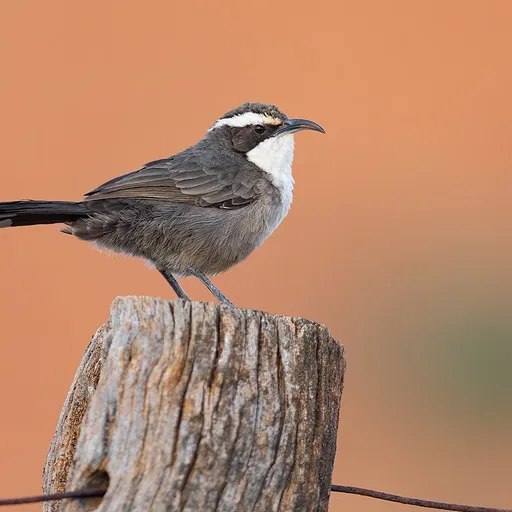
White-browed Babbler
Pomatostomus superciliosus
Least Concern
Overview
The white-browed babbler (Pomatostomus superciliosus) is a small, gregarious terrestrial bird native to Australia. It is the smallest of the Australian babblers and is characterised by its social nature and preference for open woodlands and shrubby areas.
Identification
- Body length ranges from 17 to 21 cm, featuring a plump, full body, short rounded wings, and a long, graduated tail with a rounded tip.
- Plumage varies from dark grey-brown to solid dark brown, distinguished by a prominent white supercilium (eyebrow) and a dark brown eye stripe.
- Adults have a long, decurved bill, while juveniles may display chestnut or cinnamon motifs on their undersides.
- Vocalisations include a low repeated 'chuck' contact call, a long-distance chattering 'mee' followed by a rising 'wee-aw', and a group chorus of 'churring' alarms.
Habitat
Endemic to central and southern Australia, this species inhabits dry sclerophyll woodlands, shrublands, heathland, semiarid grasslands, and open forests. It generally occurs south of the tropic of Capricorn, crossing the South Australian coastline to Western Australia, and prefers areas with dense understory for protection.
Diet
The diet is varied and includes insects, spiders, amphibians, crustaceans, reptiles, fruit, seeds, and nuts, mostly foraged from the leaf litter on the ground. Adults often use a log or branch as a base to hide in and return to, rarely venturing far from known feeding areas.
Did you know?
This species is famous for its co-operative breeding system, where groups of two to four pairs and other individuals take turns incubating eggs and repairing nests. They have also been found nesting in human-related infrastructure such as golf courses, orchards, and buildings.
Sources
- Wikipedia · CC BY-SA 4.0
- Wikidata · CC0 1.0