
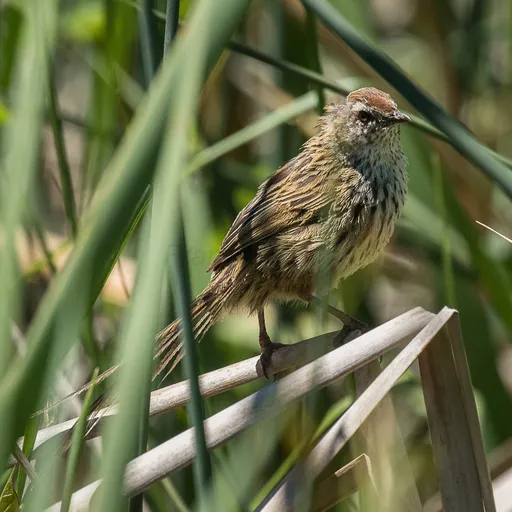
New Zealand Fernbird
Poodytes punctatus
Least Concern
Overview
The New Zealand fernbird (Poodytes punctatus) is an insectivorous bird endemic to New Zealand, known in Māori as kōtātā or mātātā. It is a reluctant flier that primarily moves through vegetation, though it can occasionally fly short distances just above the ground. Once described as one of the most common birds in the 19th century, it is now rare due to habitat loss.
Identification
- Rich brown plumage above with black streaking on the head, upperparts, and wings, and whitish, finely mottled underparts with brown spots on the throat and breast.
- Approximately 18 cm in length, with a long, thin, spine-like dark brown tail that constitutes almost half its body length.
- Blackish beak with a greyish lower mandible, dark brown eyes, and pinkish-brown legs and toes.
- Song consists of rapid metallic whistles and clicks; pairs perform a duet where the male calls a sonorous 'uu' and the female responds with a high-pitched 'tick'.
Habitat
This species inhabits wet shrubby environments, including swamps, peat bogs, ponds, and temperate shrublands, often preferring low dense ground vegetation near estuary margins. Its range is extensive across New Zealand, with different subspecies found on the North Island, South Island, Stewart Island, Codfish Island, and the Snares Islands. Although it occupies a large area of approximately 657,000 km², its population has declined due to the destruction of natural wetland habitats.
Diet
The New Zealand fernbird is insectivorous, feeding on caterpillars, larvae, beetles, flies, and moths, as well as small spiders emerging from cocoons. It occasionally consumes seeds and fruits to supplement its diet.
Did you know?
Māori revered the fernbird as an 'oracle' or 'wise bird', interpreting its calls as omens that could herald success or failure in daily activities such as fishing, or even portend prosperity and health versus disaster and death.
Sources
- Wikipedia · CC BY-SA 4.0
- Wikidata · CC0 1.0