
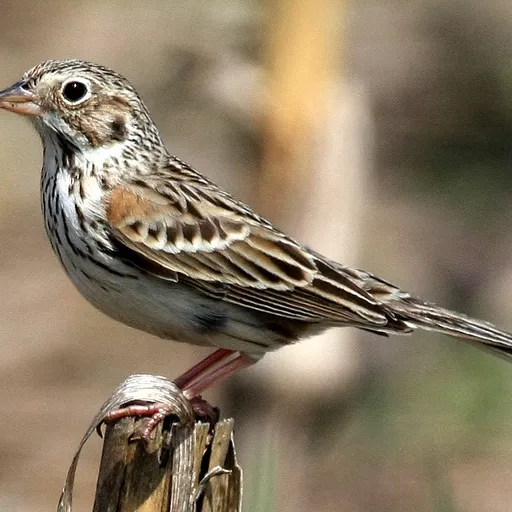
Vesper Sparrow
Pooecetes gramineus
Least Concern
Overview
The vesper sparrow (Pooecetes gramineus) is a medium-sized New World sparrow and the only member of the genus Pooecetes. It is characterised by its pale plumage with brown streaks and breeds across the grasslands of northern North America before migrating to winter in the southern United States and Mexico.
Identification
- Overall length of 14–16 cm with light brown upper-parts and light under-parts featuring darker streaking.
- Possesses a small, white ring surrounding the eyes and a chestnut patch on the shoulder, though the latter is usually not visible.
- Displays a flash of white tail feathers during flight and lacks a bold eyeline.
- Males sing a musical song from high perches like shrubs or fenceposts, consisting of repeated whistled notes and trills similar to the song sparrow.
Habitat
Primarily found across Canada and most of the northern United States, these birds inhabit lower elevations in grassy areas such as dry grasslands, sagebrush, and fields. Around September, they migrate to the eastern and central United States, Mexico, and the Gulf Coast, returning north in March.
Diet
Vesper sparrows forage on the ground, feeding mainly on insects and seeds. Outside the nesting season, they often feed in small flocks.
Did you know?
The genus name Pooecetes combines the Ancient Greek words for 'grass' and 'dweller', while the specific epithet gramineus is Latin for 'grassy' or 'grass-like'.
Sources
- Wikipedia · CC BY-SA 4.0
- Wikidata · CC0 1.0