
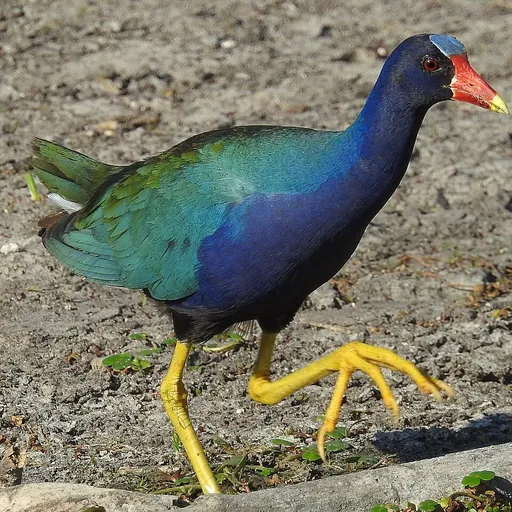
Purple Gallinule
Porphyrio martinica
Listen
XC759721 · radrat · Club de Yate Miraflores-R (near Panama City), Panama, Panamá Province, Panama · CC0 1.0
Overview
The purple gallinule (Porphyrio martinica) is a medium-sized rail found in the Americas and also known locally as the yellow-legged gallinule. This species belongs to the family Rallidae and the order Gruiformes. It is a ground-feeding omnivore that inhabits freshwater marshes with dense vegetation.
Identification
- Adults feature purple-blue plumage that shines green and turquoise in good light, contrasted by a pale blue forehead shield.
- The bill is red and yellow, while adults possess bright yellow legs and feet; immature birds have brown-yellowish legs, and juveniles have brown legs.
- Males are slightly larger than females, with average masses of 257 g and 215 g respectively.
- Immature birds are brown-bronze with purple chest feathers, and juveniles are light brown with green-bronze hints on the wings and back.
Habitat
These birds inhabit freshwater marshes with dense stands of vegetation. They are resident in southern Florida, the coasts of Mexico, parts of Central America, and the Caribbean, while breeding in the southeastern United States. Their range extends into South America during migration, with occasional strays recorded as far north as Canada and Iceland.
Diet
Purple gallinules are omnivorous ground feeders that consume a variety of plant and animal matter, including seeds, leaves, fruits, insects, frogs, and fish. They have also been known to prey upon the eggs and young of other bird species, such as the jacana.
Did you know?
The species exhibits the greatest pattern of vagrancy amongst rails, with individuals recorded in locations as distant as Iceland, Great Britain, Portugal, and Cape Verde. Despite twenty-one records in the Cape Province of South Africa, these were mostly juveniles, making a breeding ground establishment there very unlikely.