
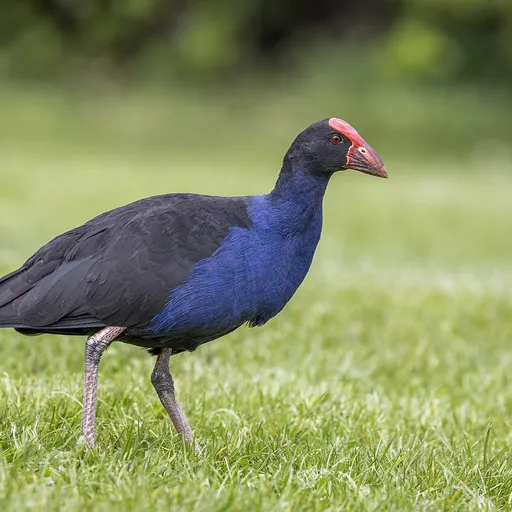
Australasian Swamphen
Porphyrio melanotus
Listen
XC727041 · Richard Fuller · Carindale, Brisbane City, Queensland, Australia · CC0 1.0
Overview
The Australasian swamphen (Porphyrio melanotus), known as the pūkeko in New Zealand, is a striking and socially complex bird found in Oceania. It is a member of the rail family and exhibits phenotypic characteristics typical of rails, such as relatively short wings and strong, elongated bills adapted to a semi-aquatic lifestyle.
Identification
- Dark plumage with black upper-parts, a contrasting white undertail, and purple throat and breast.
- Large, bright red bill with an expanded frontal shield extending from the culmen.
- Long, strong red legs and large feet that allow traversal of swampy terrain without sinking.
- Approximately 51 cm in height, with some subspecies showing greener or bluer upper-parts.
Habitat
Primarily inhabits swamps, marshes, estuaries, and riverbanks across Southeast Asia, Australia, and New Zealand. The species is highly adaptable and has expanded into pastures, crops, farm ponds, road verges, and forest margins, particularly in New Zealand following landscape changes. It thrives in both natural wetlands and human-modified environments.
Diet
Consumes plant material such as stems, shoots, leaves, and seeds of grasses, sedges, rushes, and clover, supplemented by invertebrates. It is an opportunistic feeder that has been observed preying on eggs and chicks of other bird species, including pied stilts, blackbirds, and ducks. It forages in diverse locations, including roadsides where it seeks out invertebrates struck by vehicles and ingests grit to aid digestion.
Did you know?
Swamphens exhibit a rare avian breeding system known as joint laying, where multiple females in a group contribute eggs to the same clutch. Each female's eggs differ in colour and size, allowing for individual recognition within the shared nest, though this can result in lower hatching rates when clutch sizes become large.