
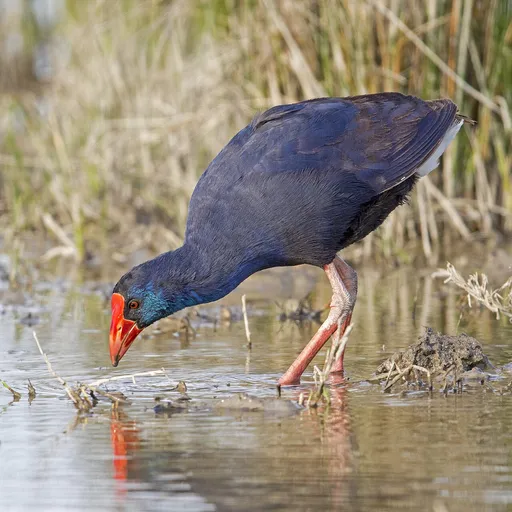
Western Swamphen
Porphyrio porphyrio
Least Concern
Listen
XC432226 · Joost van Bruggen · Área Metropolitana de Sevilla (near Isla Mayor), Sevilla, Andalucía, Spain · CC BY-SA 4.0
Overview
The western swamphen (Porphyrio porphyrio) is a chicken-sized rail found in the wetlands of southwestern Europe and northwestern Africa. It is currently listed as Least Concern on the IUCN Red List and is the largest member of the western Mediterranean purple swamphen complex.
Identification
- Distinctive large feet that allow it to walk on floating vegetation.
- Bright plumage featuring a prominent red bill and frontal shield.
- Emits loud, quick, bleating and hooting calls that sound hardly bird-like, especially during the breeding season.
- Chicken-sized body that, despite being clumsy in flight, can travel long distances and is a strong swimmer for a bird without webbed feet.
Habitat
Native to wetlands in Spain, Portugal, southeastern France, Italy (Sardinia and Sicily) and northwestern Africa. The species prefers environments with high rainfall, including swamps, lake edges, damp pastures, and warm reed beds, and has even been recorded living in paddy fields.
Diet
The western swamphen forages by clammering through reeds to feed on tender shoots and vegetable-like matter. It also consumes animal prey such as eggs, ducklings, small fish, and invertebrates like snails, often using one foot to bring food to its mouth rather than eating directly on the ground.
Did you know?
Ancient Greeks and Romans kept western swamphens not for food but as decorative birds in villas and temples, where they were frequently depicted in mosaics and frescos, such as the famous garden fresco from Pompeii.
Sources
- Wikipedia · CC BY-SA 4.0
- Wikidata · CC0 1.0