
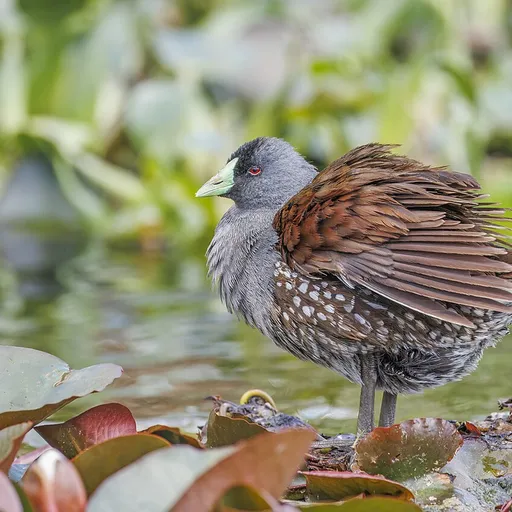
Spot-flanked Gallinule
Porphyriops melanops
Least Concern
Overview
The spot-flanked gallinule (Porphyriops melanops) is a small waterfowl-like bird in the family Rallidae. Although currently classified within the genus Porphyriops, recent chromosomal research suggests it is more closely related to Gallinula chloropus, though its binomial nomenclature remains unchanged pending further study.
Identification
- A small bird averaging 28 cm in length and 154–225 g in weight, featuring a slate grey head, chin, neck, and breast contrasting with a black forehead and crown.
- Brown covert feathers and flanks marked with white mottling, with a pale green bill that develops with age, transitioning from a juvenile black and pink colour.
- Drab green-grey legs that are rarely visible due to the bird's aquatic habits, and eyes that mature from black to vibrant red.
- Vocalisations include a cackling 'ke-ke-ke-ke' sound and a quick clicking noise, often accompanied by a low-pitched whoop.
Habitat
Found across South America, including Argentina, Bolivia, Brazil, Chile, Colombia, Paraguay, Peru, and Uruguay, with larger populations in Brazil, Argentina, Chile, Paraguay, and Uruguay. It inhabits natural wetlands, swamps, and freshwater lakes, but also thrives in ornamental lakes, artificial ponds, and grassy parks with emergent vegetation. The subspecies P. m. bogotensis is isolated in Colombia, distinct from other breeding populations.
Diet
An omnivore that feeds on plants such as Polygonum acuminatum and horsetail paspalum, as well as snails, insects, and seeds. It forages by swimming among floating or rooted aquatic vegetation, though Colombian populations have shown preferences for Leptospermum laevigatum and sesame seeds.
Did you know?
The spot-flanked gallinule is unique among bird species for possessing a W chromosome that is larger than its Z chromosome.
Sources
- Wikipedia · CC BY-SA 4.0
- Wikidata · CC0 1.0