
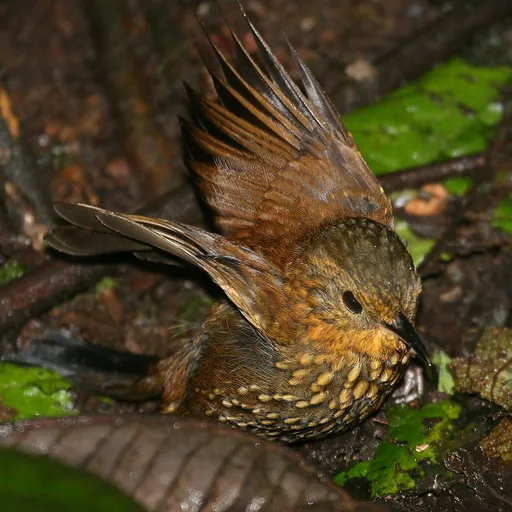
Spotted Barbtail
Premnoplex brunnescens
Least Concern
Listen
XC248903 · Niels Krabbe · Napo: pass of Cord. de los Guacamayos, Ecuador · CC BY-SA 4.0
Overview
The Premnoplex brunnescens, or spotted barbtail, is a small, sedentary bird in the family Furnariidae that is listed as Least Concern on the IUCN Red List. It is found in subtropical and tropical moist montane forests and is distinguished from its sister species, the white-throated barbtail, by its tawny rather than white spotting.
Identification
- Size: Ranges from 13 to 15 cm in length and weighs between 14 and 19 grams.
- Plumage: Features a dark greyish-brown forehead with tawny spots, a scalloped crown, and a chestnut-hued rump; the breast has elongated tawny spots outlined in dark brown.
- Tail: The tips of all tail feathers lack barbs, giving the tail a distinctive 'spiny' appearance.
- Bill: The upper mandible is black or dark brown, while the lower mandible varies from greyish-pink to horn-coloured, with the bird possessing a shallower beak than the white-throated barbtail.
Habitat
This species inhabits evergreen montane forests, exhibiting a strong preference for areas rich in moss and epiphytes. In Central America, it occurs between 1,200 and 2,300 metres above sea level, while in the Andes, it is found from 900 to 2,600 metres, occasionally extending up to 3,000 metres. It is common across its distribution in the Talamancan montane forests and the northern Andes, including in fragmented habitat.
Diet
The spotted barbtail feeds on beetles, hymenopteran insects, cockroach eggs, and spiders. It forages in the forest understorey by gleaning food from mossy sections of trees, crevices in tree bark, and among epiphytes, often using its tail for support to climb thin branches or hang upside-down.
Did you know?
The species constructs a 'massive ball' nest made of lichen, liverworts, moss, and tiny roots that is approximately 30 cm in diameter and features a tube-like entrance with a short tunnel leading to a central chamber. The two eggs laid are completely white and disproportionately large relative to the bird, measuring approximately 22 mm by 17 mm.
Sources
- Wikipedia · CC BY-SA 4.0
- Wikidata · CC0 1.0