
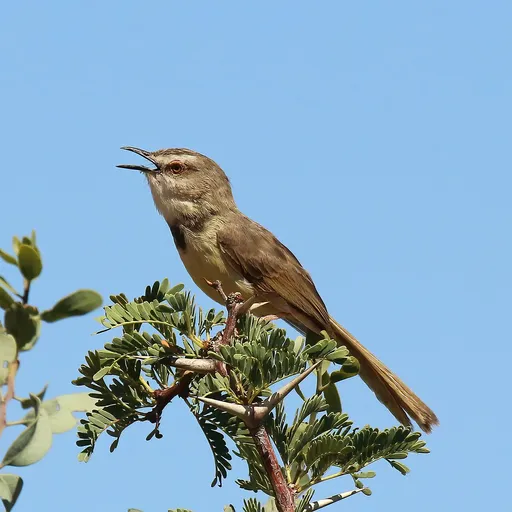
Black-chested Prinia
Prinia flavicans
Least Concern
Overview
The black-chested prinia (Prinia flavicans) is a small, long-tailed warbler in the family Cisticolidae, classified as Least Concern on the IUCN Red List. It is near-endemic to the southern African thornbelt and is the only prinia species in the region that displays distinct breeding and non-breeding plumages.
Identification
- Small, long-tailed warbler measuring 13 to 15 centimeters, typically holding its tail in a near-vertical position.
- Non-breeding plumage is pale golden-brown or pale yellow, while breeding plumage features a charcoal-colored breast band with white or buttery yellow underparts.
- Vocalisations include a loud, repeated 'chip-chip-chip' call and a buzzy sequence of 'zrrrt-zrrrt-zrrrt' sounds.
Habitat
This species inhabits dry savannas, particularly the Kalahari Basin where it is most abundant, and relies on Acacia habitats alongside Olea-Buddleia vegetation. It is found in Angola, Botswana, Lesotho, Namibia, South Africa, Zambia, and Zimbabwe.
Diet
Insects constitute the majority of its diet, with small beetles, beetle and weevil larvae, and adult flies being common prey. The bird also consumes plant matter such as seeds, leaves, and berries, and has been observed probing unopened Aloe marlothii flowers during winter.
Did you know?
This species undergoes a complete biannual molt, including flight feathers, which is quite rare in passerines; this results in a short spring molt and a longer autumn molt that may occasionally overlap with the erratic breeding season.
Sources
- Wikipedia · CC BY-SA 4.0
- Wikidata · CC0 1.0