
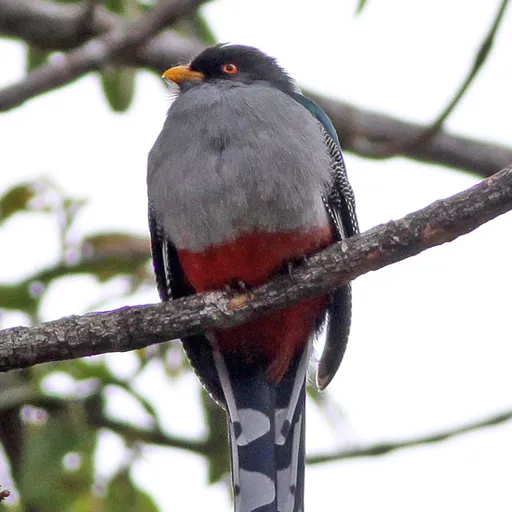
Hispaniolan Trogon
Priotelus roseigaster
Overview
The Hispaniolan trogon (Priotelus roseigaster), also known as the cacos, is a species of bird in the family Trogonidae that is endemic to Hispaniola in the Caribbean. It holds the distinction of being the national bird of Haiti and is one of only two trogon species found in the region.
Identification
- Metallic green upper parts, a gray throat and breast, and a red belly.
- Long, strongly graduated tails with dark undersides where each rectrix is broadly tipped with white.
- Small feet and short, thick bills.
- Males possess narrow white bars on wing coverts and secondaries, whereas females lack these markings.
- A rather slow song with a low rattle that can be heard from a considerable distance.
Habitat
Endemic to Hispaniola, this species inhabits subtropical or tropical moist montane forests, as well as rain, dry, pine, and broad-leaved deciduous forests. It primarily occurs at elevations of 500–3,000 m but exhibits some altitudinal migration, with birds observed at lower elevations in winter. In Haiti, it is restricted to the Massif de la Hotte and Chaîne de la Selle due to habitat loss, while it remains quite common in the Dominican Republic, particularly in the Sierra de Baoruco.
Diet
The Hispaniolan trogon mainly eats insects, though it also takes small vertebrates such as anoles and fruits, especially those of the West Indian sumac (Brunellia comocladifolia). Its foraging behaviour is presumed to involve aerial sallies to fruit or surrounding vegetation, primarily within the mid-story of humid deciduous and pine forests.
Did you know?
Although its breeding season is thought to be March to July, the lengths of the incubation period and nestling periods remain unknown. The species requires large, old decayed trees with holes for nesting and may utilise cavities created by the Hispaniolan woodpecker (Melanerpes striatus).